
Arguably the most often-uttered piece of factoid about the global AI landscape is that China produces 50% of the world’s AI talent. It is a number that Jensen Huang of NVIDIA is fond of repeating in almost every interview he does, and no interviewer has questioned where that neat, clean number came from.
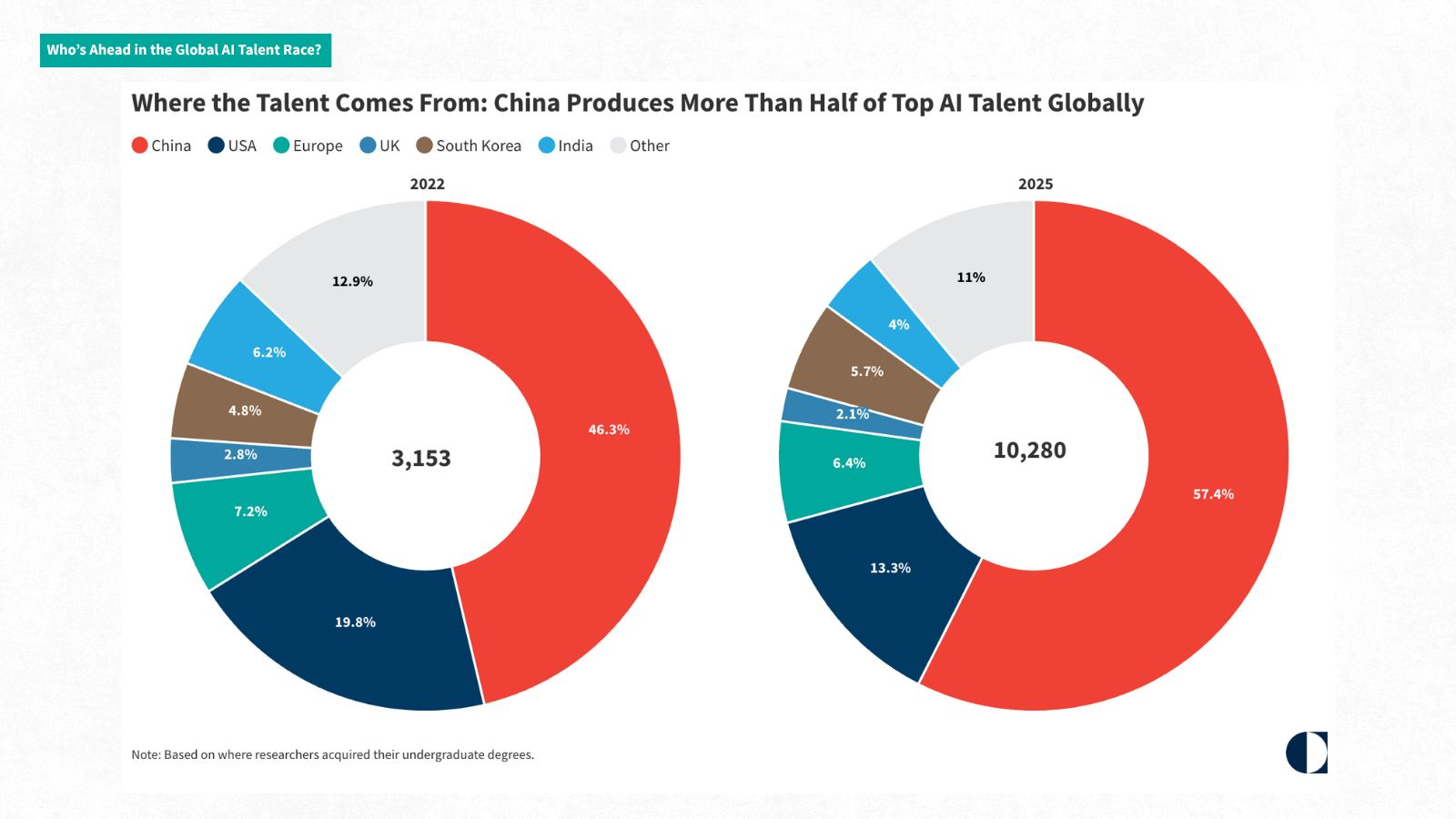
In fact, it came from a 2023 study done by the think tank, Macro Polo. As the founder of Macro Polo, Damien Ma, likes to point out, the study actually shows that 46.3% of undergraduate AI talent came from China. That 50% is directionally correct, but also a mild case of “Jensen Math”, which loves to round up.
Nevertheless, the Macro Polo global AI talent tracking which began in 2020 was an insightful, influential, and one of a kind study. I learned a ton from it and wrote about the 2023 update when it came out. So I was disappointed when Macro Polo shut down early last year with the sad assumption that this global AI talent tracker will cease to exist.
My sadness and disappointment turned into joy and delight, when Damien and his team resumed this study under the Carnegie China umbrella and published an update earlier this week. Just like the last study, it is chokeful of insights and findings that inform arguably the most important yet also the most elusive input into the future of AI: human talent.
Young and Plenty
The big headline takeaway is that China now produces 57.4% of the global AI talent (again, this is based on undergraduate degrees). This is a solid 11% increase from when the study was last done three years ago. (I can literally hear Jensen updating his talking point to “China now produces 60% of the world’s AI talent” in future interviews.)
This increase in young AI talent was viscerally evident when I went to China earlier this year and, along with a group of other western AI researchers and writers, met with almost all the top AI labs in China. One of my top takeaways from the trip was how many “crack interns” we met – young twenty-somethings, all of whom studied in Chinese universities, currently working on their PhD’s, but also working full-time as “interns” in these labs doing real research and experimentation work, not BS intern work.
The youthful vibe we felt on the trip is confirmed by this more quantitative and rigorous study. The “academia-industry” pipeline in China is real, flourishing, and arguably one of its strongest hidden strengths in AI.
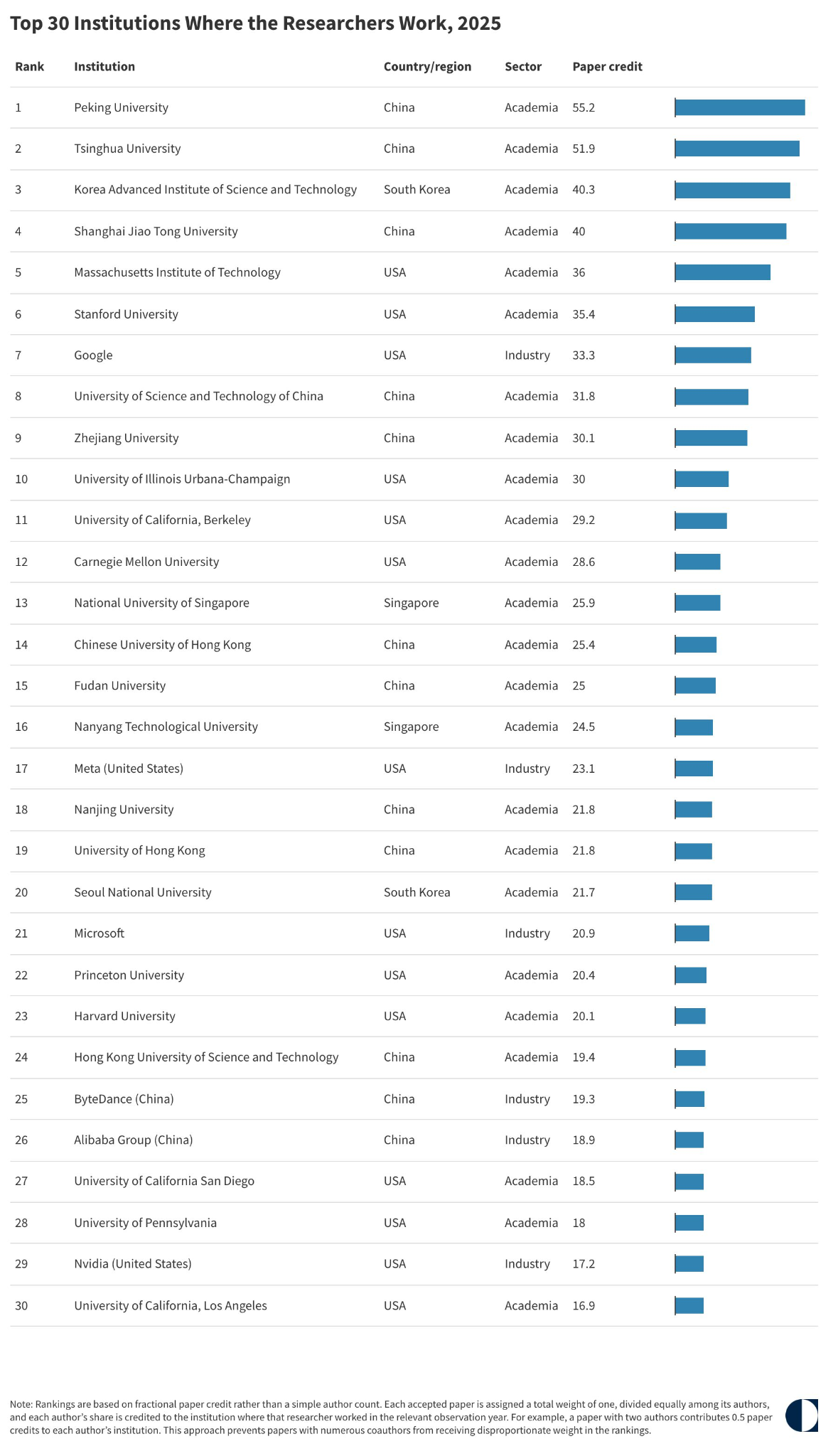
Not only is the volume of talent going up, so is the breadth of institutions where these young talents get trained from. Out of the top 30 institutions that this study tracks, Chinese organizations now account for 12 of them, compared to just 6 from three years ago. Among the top 5 institutions overall, 3 are Chinese universities (Peking, Tsinghua, and Jiao Tong). Among the 12 Chinese institutions on the list, 10 are universities, 2 are companies (ByteDance and Alibaba).
The US’s share on this top 30 list decreased a bit, but still commands the largest share. American organizations spanning both academia and industry hold 14 out of the 30 spots in 2025 versus 18 in 2022. And if OpenAI or Anthropic allows their researchers to publish something, anything, I’m sure their research would land them on this list. But that is wishful thinking. In the meantime, whether it is on raw young talent production or institutional breathe, it seems that China is gaining on the US.
The rosy prospect sort of ends there for China. America may not be producing most of the talent, but it is the biggest magnet and destination for those talents by a long shot. China, on the other hand, is losing the most talent to other countries after putting in the work and resources to educate them.
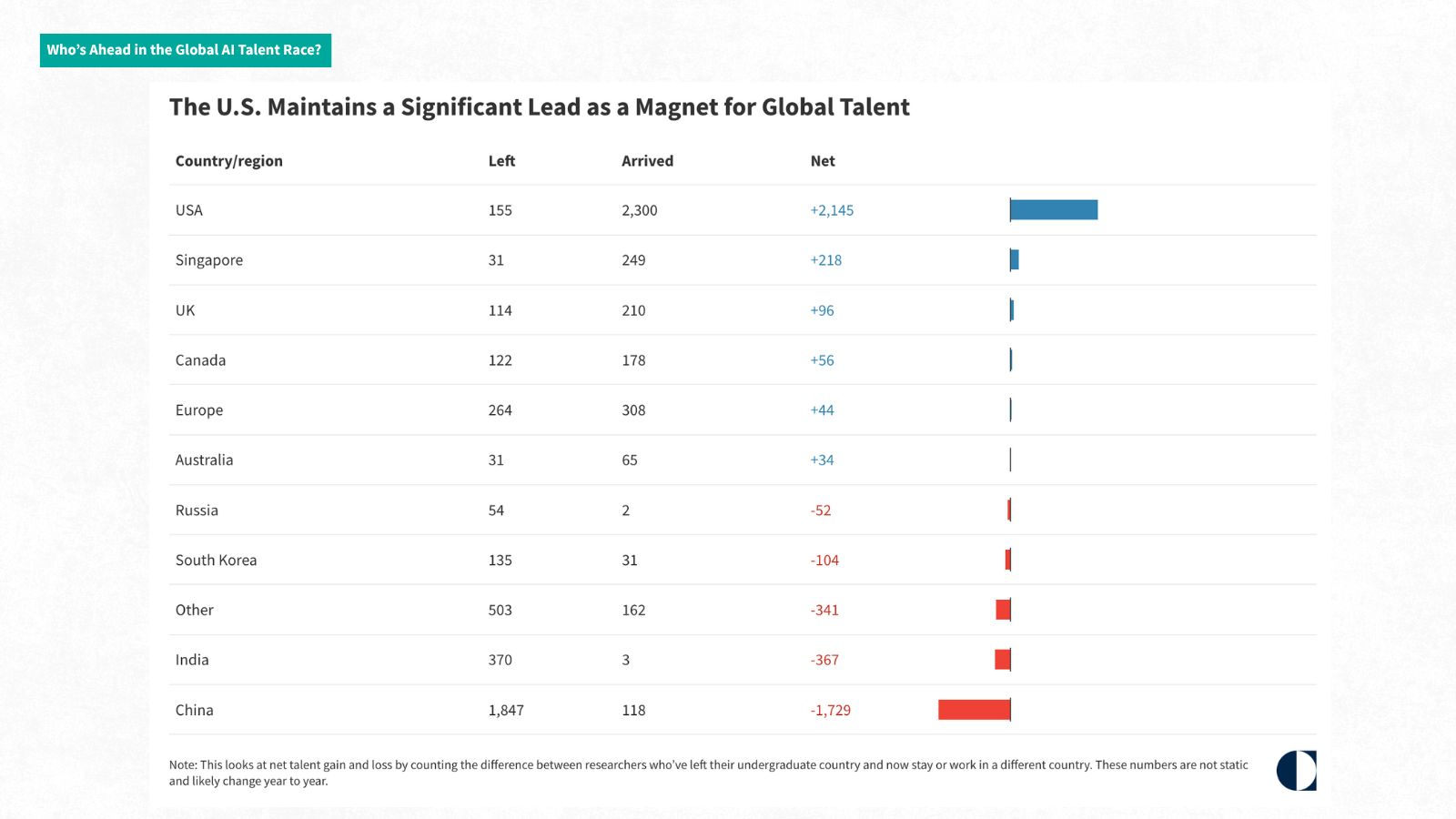
On this chart, the US and China are occupying the literal opposite end of the spectrum. The US had a net gain of +2,145 AI researchers in 2025, while China suffered a net loss of −1,729 AI talent. (This is within the sample universe that the study was conducted, which is the NeurIPS 2025 conference published paper authors.) To add insult to injury, half of the Chinese talent who leave China wound up in America. Singapore’s 2nd place spot on this list likely also came at the expense of China, since the trend of “Singapore washing” has been under way for a few years now.
The Chinese brain continues to be drained overseas.
This massive talent flow towards the US should be somewhat intuitive and unsurprising, if you work in the AI industry or monitor it closely. The American AI industry is by far the most competitive, well-capitalized, and loosely-regulated. This dynamic environment naturally attracts the best and most ambitious AI talent from around the world, whether it is for the money or for the challenge (or both). And since China produces more than half of the young raw talent, a lot of them would be drawn to the US for those reasons, despite a generally more hostile environment towards all immigrants and an increasingly specific suspicion towards Chinese technical talent working or studying in the US.
When will America’s hostility towards outsiders and foreigners (loosely and ethnocentrically defined) end up shooting itself in the foot in its pursuit of AGI is hard to tell. So far, at least backward looking to what happened in 2025, Team USA is muddling along fine.
Willing Stay or Forced Retention
Brain drain (or brain gain) aside, one surprising finding from the study is how less fluid the talent flow has become with more people staying to work in their home country (or at least home company, since the chart is based on employer's headquarters location).
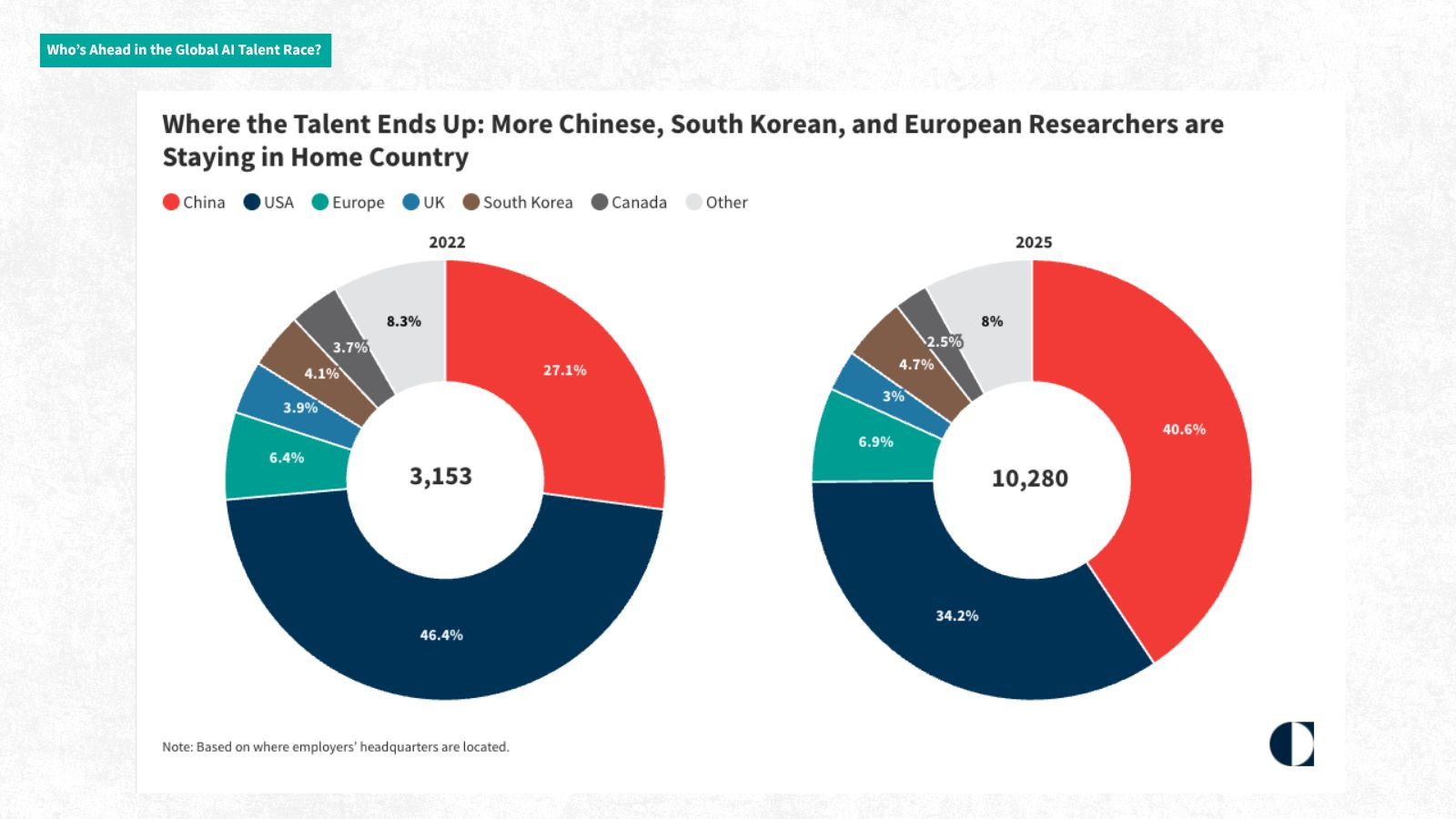
This “higher retention rate” is observable in South Korea, Europe, and also China. I think this trend will also continue as sovereign AI takes a stronger hold on how AI will evolve globally. I was originally a sovereign AI skeptic, thinking it was nothing more than a clever sales pitch to sell more chips. While the sales-y side remains true, I have come around to the reality that exerting sovereignty and control over AI is a legitimate strategic and national imperative that all countries will, sooner or later, pursue. I noted this change in my opinion two years ago, shared my updated thoughts with The Economist two months ago, and the drumbeat of sovereign AI has been louder than ever across both countries and companies.
But what has been missing in the sovereign AI discussion is the critical importance of native talent as a key input. The focus so far has been on physical and digital control of AI infrastructure: build local data centers, provide tight security around the data centers, produce own chips or at least buy them from friendly countries, use open weight models, secure data like national treasure to be used and controlled for future AI model development. These are all important elements on the road to real AI sovereignty. But what good does indigenizing the most advanced open weight model and constructing the most secure data center do, if you don’t have the people, ideally people you can call your own, to operate, support, and improve your national AI over time?
I suspect this motivation to control your own talent in service of AI sovereignty is leading to this national retention rate going up. I suspect it will continue to go up in the future. However, how this “sovereignty over talent” gets implemented is worth thinking about. Some of this retention is likely done through a combination of improving domestic opportunities, increasing resources and incentives, plus a healthy dose of appealing to national pride – the carrot. The more punitive way is exit ban, travel control, and even prosecuting your own citizens, however talented they might be, for working for foreign companies – the stick.
We already see headlines of China implementing exit bans of citizens who may know or hold important know-how’s on AI or executives from leading AI labs needing government approval to travel abroad. The Manus acquisition by Meta was thwarted by the government and the startup’s founders were not allowed to leave China until the deal was officially dead.
South Korea is even more draconian in this regard, having expanded its espionage provisions in its criminal law to prevent leakage of semiconductor technologies. The South Korean government has brought almost 100 cases over the last several years related to technology leakage, many of which involve its own citizens. I have a feeling that these tough measures and chill effects moved the needle more than a little bit in boosting the retention rate observed in the chart above.
Are more top AI talent staying home willingly or being forced to? How does the scarcity of AI talent influence a country’s overall AI, education, and industrial policy? Is the free flow of talent and knowledge a feature of human advancement we should embrace or a bug of national security that we should reduce?
These are all extraordinarily important and difficult questions that this study highlights, but cannot answer. As we look to future updates of this study, and hopefully more studies like it, even the source of data is being challenged by national borders and geopolitical tension over talent. As mentioned before, this Carnegie China study leverages paper publication authorship data from the 2025 NeurIPS conference, which had to host the event in both San Diego and Mexico City, where the latter location is a backup plan for researchers, predominantly those from China, who could not secure a US visa. This year’s conference almost excluded publication submissions from all organizations that are on the US entity list, which China’s Association for Science and Technology protested against, and the decision was rolled back, for now.
If the draw bridge is threatened to be pulled up on even academic conferences, the most fluid and innocent form of human talent exchange, the hope for more talent flow among companies, industries, and governments is dim.
Tech, especially the Silicon Valley version, is fond of rebranding The Lord of the Rings references, but mostly the dark ones – Palantir, Andúril, the Eye of Sauron. There is another Tolkien throughline that is more wholesome, adventurous, and taps into the inner goodness and natural curiosity of humanity. The prelude to the war and destruction of The Lord of the Rings was, after all, Bilbo Baggins’s memoir, There and Back Again. It was a chronicle of the hobbit’s ventures outside his comfort zone, explorations of foreign lands (and a dragon) in the rest of Middle Earth, who returned to the Shire on his own free will to share his stories and treasures with the folks at home.
It is hard to imagine and pointless to romanticize top AI talent doing their own version of There and Back Again these days, freely flowing and roaming to whichever company or country to fulfill his or her curiosity and ambition, but also leaves room for homesickness and ancestral familiarity, if craved. But I’m glad that at least the definitive study that tracks this story is back again.