
The world is barreling toward another US-China summit with a bilateral AI dialogue possibly happening this weekend. Meanwhile, every human is wrestling with whether a 10-ish% of AI accelerated extinction is worth losing sleep over. (I suddenly have a lot of empathy for dinosaurs in the Cretaceous Period.)
With all that occupying our minds, it’s understandable that one important development fell through the cracks: a China-led BRICS AI open source community. This proposal was the first of five initiatives Xi Jinping put forward during his official remarks at the BRICS summit that just concluded in India. (BRICS stands for “Brazil, Russia, India, China, South Africa”. It is a group of major emerging economies that first got organized into a group in 2009.)
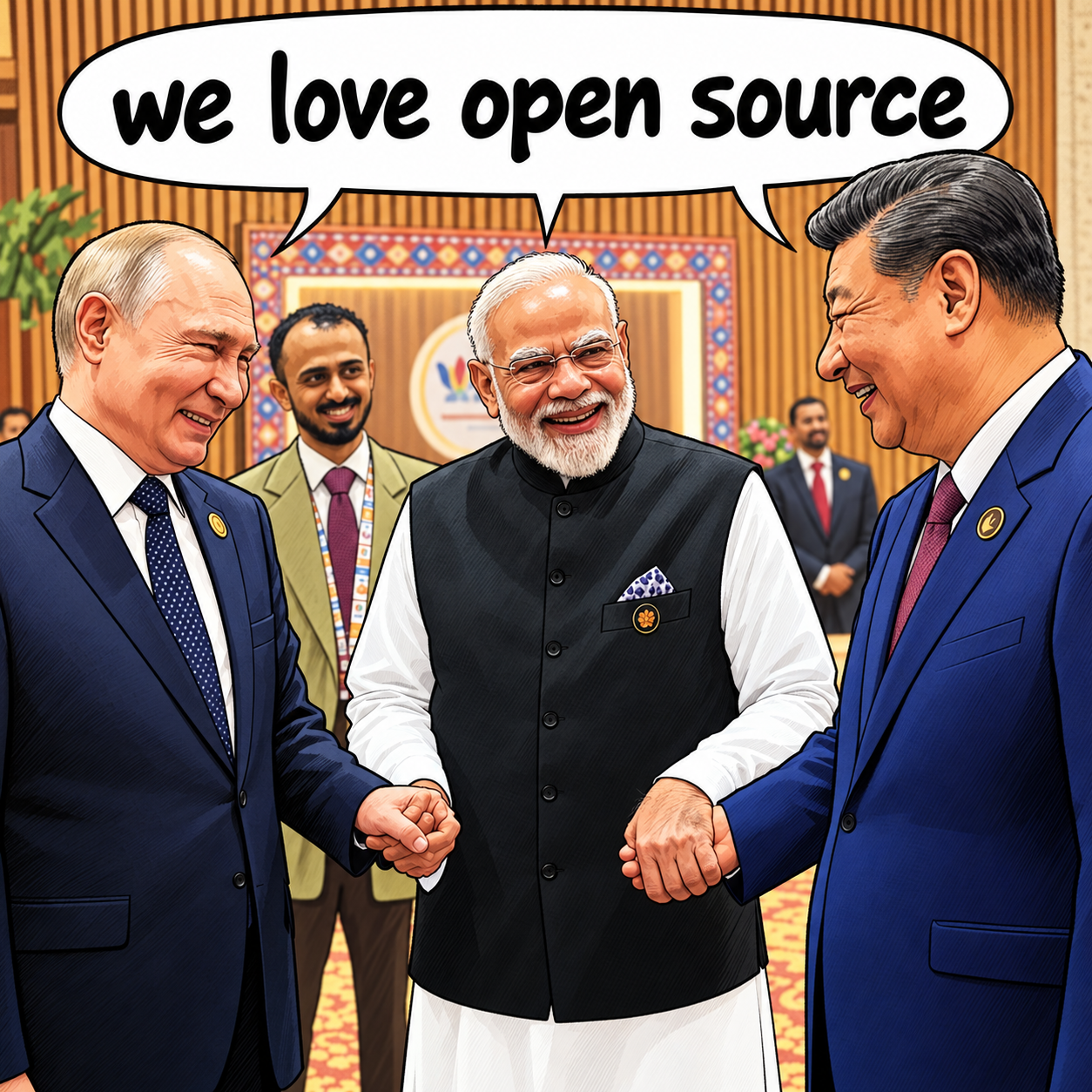
The only thing that got much attention in the media was a kumbaya photo between Modi, Xi, and Putin that might’ve irked the western foreign policy intelligentsia. But this BRICS AI open source ecosystem would have much bigger strategic implications to where the western world would stack up in the global technology landscape in the next decade.
When I led the international expansion strategy at GitHub, the Microsoft-owned developer platform that hosts more than 90% of the world’s open source software, I was in charge of growing the company’s market presence beyond our home turf, the United States. My time in the role straddled the pre and post-ChatGPT era, so I saw both where the global open source momentum was going before AI, and how AI changed and accelerated things.
Before ChatGPT, India and Brazil were already two of the largest and fastest growing developer markets in the world. The software engineers, hackers, and STEM students there were skilled, eager, and in many ways ignored. After formalizing a strategy and solidifying programs and resources to focus on those two markets, GitHub’s developer mind share and product market share grew like wildfire. The potential was always there and the demographic was ripe. All that was needed was some kindling and TLC.
After GitHub introduced Copilot in the summer of 2022, the AI-assisted coding product that predated ChatGPT by a few months, developers from India and Brazil, along with other countries in the Global South, took to it immediately. The same goes for companies. Some of the largest early paying customers of Copilot were from India and Latin America, when it was still a glorified autocomplete interface and nowhere as capable as it is today with all the agentic abilities.
BRICS countries and the Global South are, in fact, early adopters of many new technologies, not laggards to their western peers.
Had I stayed in my role at GitHub longer and didn’t feel the entrepreneurial itch to start my own investment fund, Indonesia would have been my next big target market to grow into. All the indicators that made India and Brazil ripe for expansion were visible in Indonesia in 2023.
Fast forward to today, how are these BRICS developer markets doing with the global AI wave in full swing?
I checked the 2025 Octoverse report, an annual report that GitHub publishes using its unrivaled internal data to paint a picture of the worldwide open source landscape. Here is the list of the top 10 countries by number of open source contributors and volume of their contributions.
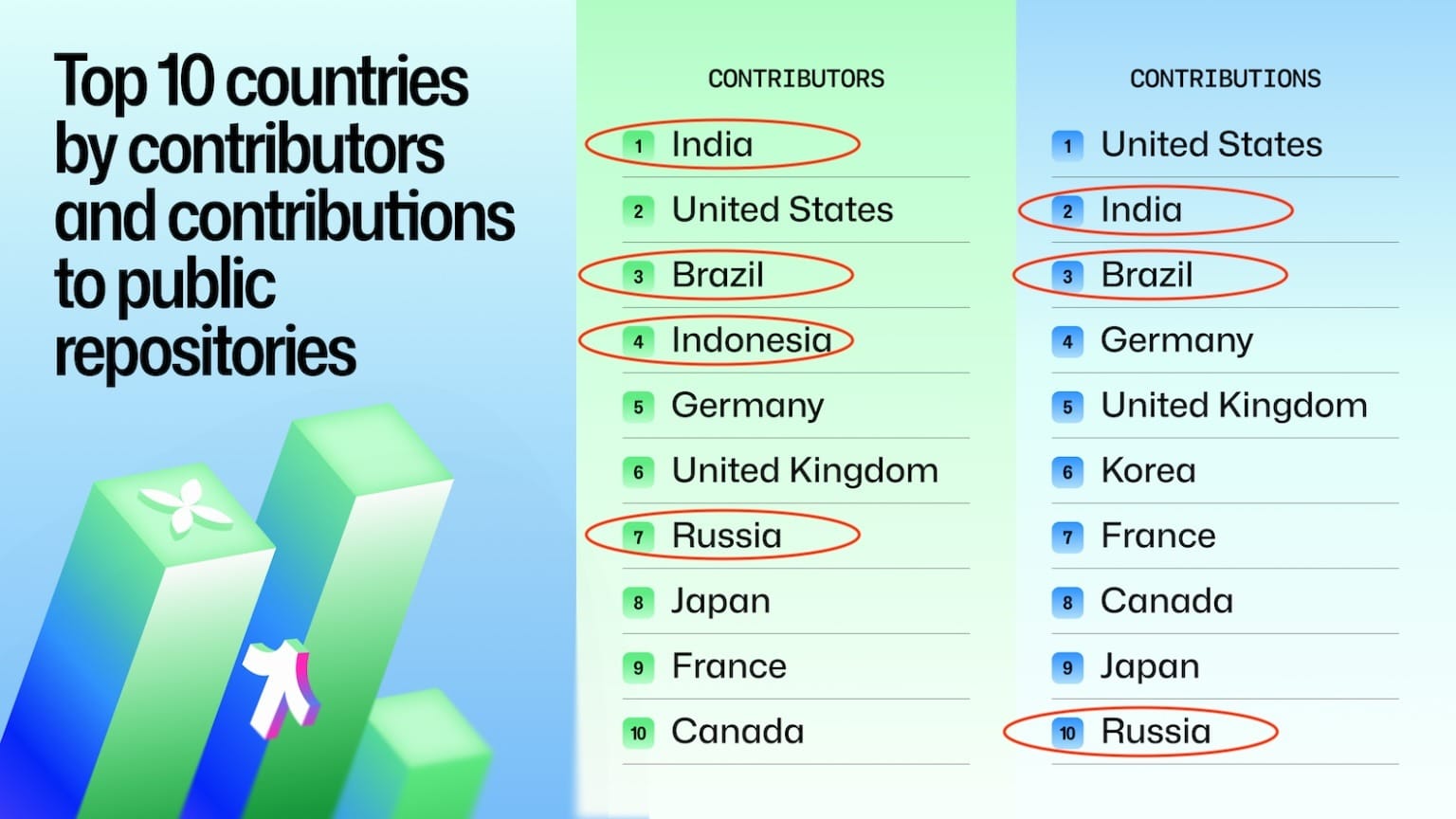
Among the BRICS members (which I red circled), India and Brazil are solidly in the top 3 in both categories. Indonesia’s contributors now rank number 4. Russia, despite war, sanctions, and being cut off from much of the global economy, is still hanging on in the top 10 in both rankings.
Where is China on the list, might you ask?
Even since the US-China relationship began to break down and a zero-sum technology competition became the predominant, if not the only, issue permeating this relationship, GitHub’s accessibility in China has been challenging, so user data has been unreliable. Many companies and developers there still use GitHub, because the source code management product is still central to many tech companies. However, many use VPN or tunneling through Hong Kong to get better performance and lower latency. Thus, many Chinese users would show up as users from other countries. China has also been propping up domestic alternatives, like Gitee and GitCode, so GitHub’s user base is certainly diminishing there. But the absence of China on the Octoverse ranking should not be interpreted as China not driving open source actively, when the opposite is happening with its AI labs pumping out open weight AI models on a monthly basis.
In a similar vein, the lead that the United States is enjoying on the rankings is likely fueled by immigrants. The biggest categories of GitHub users are tech companies, IT departments of enterprises, and academic institutions, all populated by immigrant engineers and students from India, China, and other countries. The ranking is based on the user’s account location, not a nationality or citizenship check. So a strong BRICS contingency is no doubt present in the United States, at least in the reality of tracking open source contributors and contributions.
It is not hard to see that a cohesive BRICS AI open source community would be a force to be reckoned with.
Open Source Educates Your People
Why is China trying to lead this BRICS AI open source community?
The reflexive explanations would be yet another attempt by China to dominate the Global South, increase its sphere of influence, overcapacity of digital goods just like its manufactured goods, etc.
What I think is the deeper, more strategic consideration here is tying open source and technical education together in a way that is exportable. China does not just want BRICS countries to passively use its technology, it wants to teach them how to build technology, where open source is the throughline.
The connection between open source and technical education is criminally underexplored in the geopolitical and industrial policy circles. Yet that relationship is literally how every innovation ecosystem functions. Every person who’s learned how to code or engineer leveraged open source. The Stanford/Berkeley-venture capital-startups/big techs revolving door that makes up Silicon Valley runs on open source. Guess what? So does the same tech ecosystem in Beijing, Bangalore, and Sao Paolo.
China has been a huge beneficiary of open source as an educational engine to level up its best talent. It has an equalizing effect that moderates the otherwise hypercompetitive and hyperskewed higher education market there. Only a few of the chosen ones get to go to Tsinghua and a small handful of other top technical institutions. Yet, China obviously sports way more capable technical talent than the sum of the graduating classes of those institutions. How did the rest of them level up? Oftentimes by being able to access, customize, reverse-engineer, and learn from other developers from overseas on a platform like GitHub. No intuition payment or tortuous entrance exams, just need an internet connection.
This permeation of open source in the Chinese technical education system has been going on for more than two decades. The outcome is self-evident. It is an outcome that India, Brazil, Russia, Indonesia and other countries of the Global South all want for themselves. That’s why in both Xi’s BRICS summit remarks and his World AI Conference (WAIC) speech, open source and China’s AI posture was tied to “holding specialized AI seminars and training courses” and offering “5,000 opportunities in AI training and seminar programs” for developing countries”.
Open source and educating your own people are two peas on a pod. Yet, I have not seen much analysis and commentary that ties them together to interpret the strategic reasoning behind what China is doing with AI on the global stage.
The thing is China’s pole position to spread technical education with open source is not an inevitability. For a long time, China did not produce or contribute much to open source, even though it took a lot from open source to develop its digital economy, IT infrastructure, and educate its people – a thread I explored in more detail in my history of Chinese open source.
AI changed everything. More specifically, leading Chinese AI labs aggressively leaned into open source to gain global traction while leading American AI labs closed themselves off and created a vacuum. China now produces a full-stack, all open sourced offering plus (at least for now) a commitment to openness that makes exporting its AI curriculum to the BRICS countries real.
That offering, combined with the fast growing developer population in India, Brazil, Indonesia, and elsewhere in the Global South which is already in-flight, makes a BRICS AI open source community led by China a force no one should sleep on.