
In May, when Trump visited Xi in Beijing, I compared it to watching the Super Bowl for US-China relations nerds. If that was the first quarter of the championship game, then we just had the second quarter last week, when Xi visited Trump in Washington, with the third and fourth quarters officially booked. (Both leaders invited each other to meet again during the November APEC Summit in Shenzhen and the December G20 Summit in Miami; both cheerfully agreed.)
Much of the coverage and commentary about the second quarter zoomed in on the pomp and pageantry of Xi’s first state visit to the US capital in 11 years, when my old boss Obama was president. By rolling out the literal red carpet, wrinkles and all, every time Xi’s shoes were about to touch American soil, Trump got chided a fair bit by parts of the media he attempted to ban and a good chunk of Congress he wished never existed, for being way too nice to the leader of the world’s biggest communist party.
The chiding and meme-making started almost immediately, when Trump broke all protocol to personally greet Xi at Andrews Air Force base, launched a few cool American airplanes to show respect (and show off), only to wince at the thunderous flyover while Xi looked unimpressed and jetlagged. Saturday Night Live compared Trump’s eager airport pickup to being “a boyfriend with no job”.
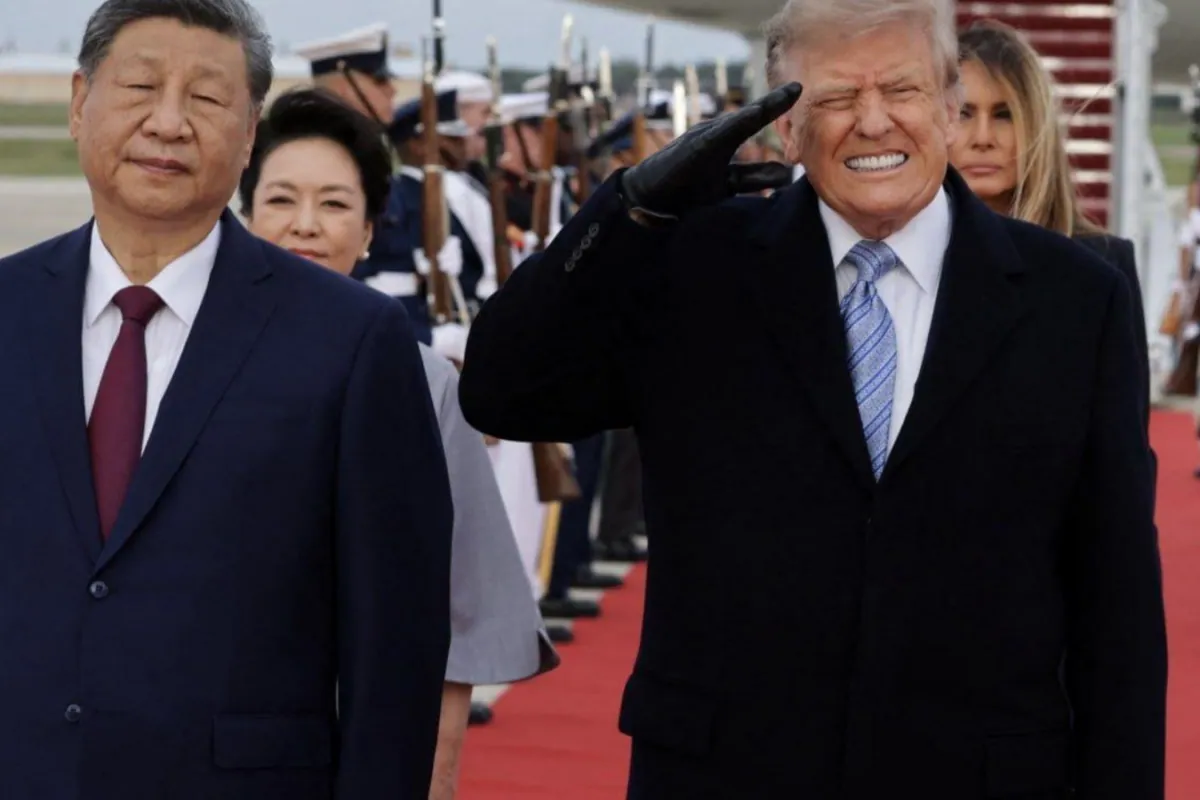
Over-indexing on the goofier side of the coverage would make you think that Trump so desperately wanted Xi to come, while Xi only obliged so Trump would stop texting. A closer look at the timing, circumstance, and how the first quarter in May went down suggests a more mutual affection.
Lest you forget, the Mid-Autumn festival was also last week, a major Chinese holiday that involves lots of family gathering and mooncake-eating that only the Lunar New Year could rival. Yet, as 1.4 billion Chinese people woke up on the morning of September 25 to celebrate this holiday, their dear leader was halfway around the world in the White House East Room, making toasts and clinking glasses with the American president and tech CEOs. Xi wanted to be there as much as Trump wanted to have him.
This level of commitment from the Chinese side was already on display when Trump visited in May. Remember, Jensen Huang was a last minute addition to the American delegation, the sort of improvisation that’s typical of Trump’s style but rarely tolerated by a more rigid, protocol-heavy Chinese counterpart. Yet, to make things work, China “rolled with it” and Huang attended every official event available to other CEOs and stayed longer in China afterwards to eat street food. Marco Rubio, the secretary of state and featured guest on the Chinese sanctions list, was also allowed to enter China on that visit without any issue, just so he could admire the ceiling of the Great Hall of the People. We still don’t know exactly what legal and diplomatic gymnastics were exercised to render the list temporarily obsolete, but when the leaders want to hang, all lists are pretty obsolete.
The truth is both sides want these visits to happen as badly as the other and are willing to bend rules and break protocols to make the occasions special, even though neither side wants to let on as much.
Two Old Men Doing More Stuff
When I wrote a tongue-and-cheek post about the May visit, what struck me was how much time the two heads of the two most powerful countries, one 80-years-young and the other seven years more junior, spent doing normal stuff that old men do. In particular, we saw Xi give Trump a rare tour of the mysterious Zhongnanhai, where Chinese leaders live and work, and most of what they talked about, at least on camera, was how old all the trees were in the yard.
On day one of the US state visit, as Xi’s plane touched down with Trump waiting on the tarmac, I wondered if these two old men would be doing more old men stuff. They did not disappoint.
On day two, Trump apparently cut his official meeting time with Xi short, because he wanted more time to show Xi stuff around the White House. They toured the West Wing, where Trump showed a large photo on the wall, known in White House parlance as “jumbos”, of him and Xi hanging out in Beijing.
They walked along the West Colonnade, where past presidents’ portraits are displayed, and made fun of the “auto-pen” portrait at the expense of another old man and democratic traditions writ large.
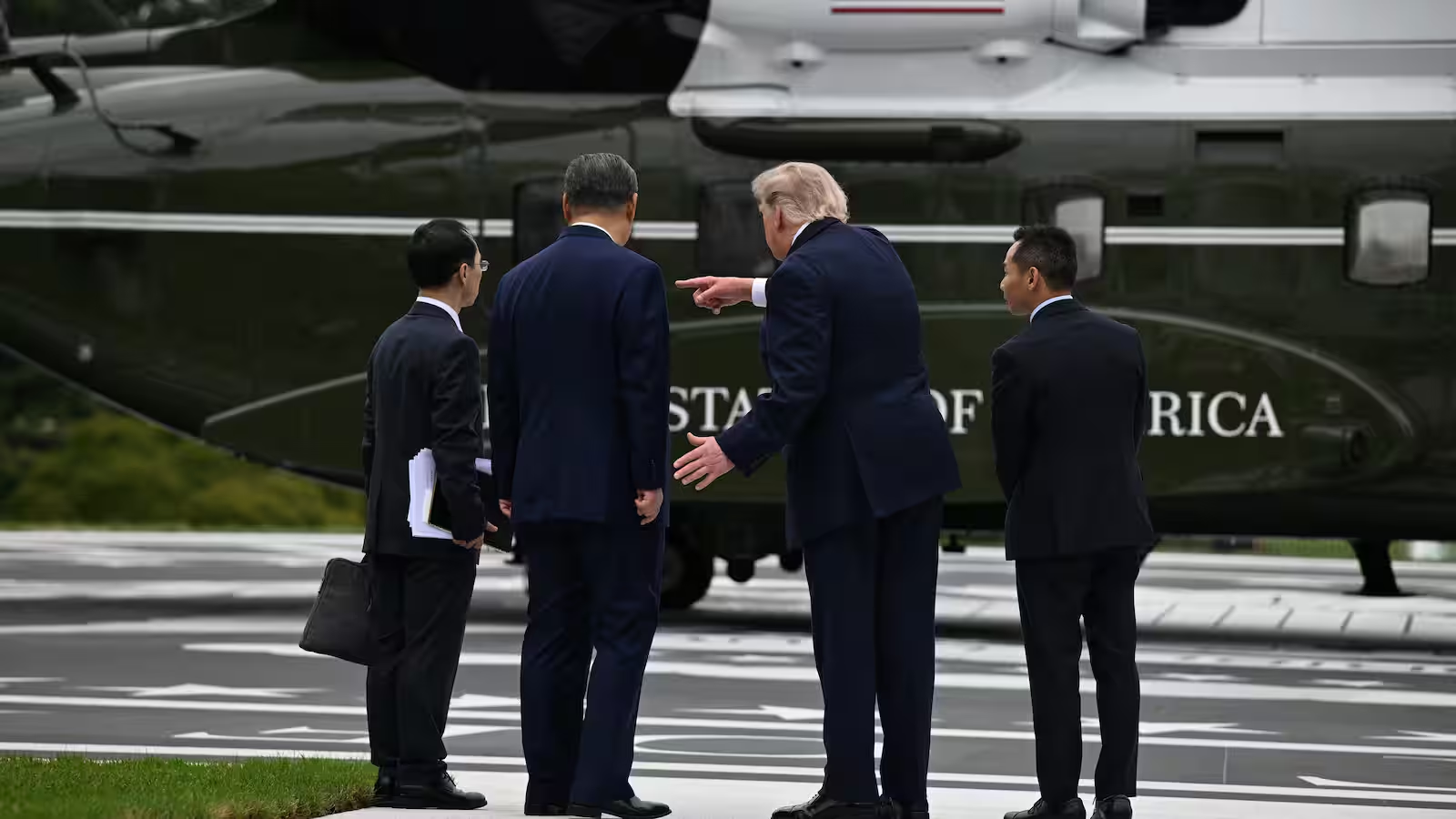
Finally, as if to say: “want to see what else I’ve done to the place?”, Trump took Xi out back to check out the newly-constructed helipad that lands the presidential helicopter, Marine One. When mugged by the press after the tour, Trump told the media he tried to ban that Xi “likes granite” and is “an expert on stone, and he loves good granite”, as Xi looked on amused.
Granite is indeed the critical material (though not exactly a rare earth) that was used to build the new helipad, especially the Seal of the President. As for whether Xi ever did have any expertise or strong opinion about granite, Julian Gewirtz found that in 2021, Xi admired the longevity of granite while inspecting a railway project in Tibet. So the personal appreciation for granite isn’t exactly made up. Was this piece of random historical factoid about Xi in Trump’s briefing book though? I have my doubts.
Regardless, the momentum of the US-China Super Bowl has decidedly shifted from touching old trees to feeling old stones that would last a million years, long after either AI or SI wipes out humanity.
On day three, the last day of the visit, the finale was a date at the museum. Here is a video I found of the two old men’s entire 8-minute tour of the National Archive, where both admired the original Declaration of Independence and the Constitution.
The audio and acoustic quality was not as good as the Zhongnanhai tree tour, but it appeared that Xi showed as much interest in learning about the founding documents of the United States of America as Trump showed about the old trees dating back to the Qing Dynasty. At various moments of the tour, Xi leaned in to observe the documents up close. He asked about how many signatures are on the Constitution (he thought he saw 30), to which the museum curator confidently answered, “There should be 54.”
At one point, unprompted, Trump started admiringly telling his two honored guests, both of whom are in fact Chinese, that China’s history is 6,000 years long (somehow 1,000 years more than the official talking point of the Chinese government), so much longer than the 250 years that America has racked up. After smiling approvingly, and perhaps also to make sure his buddy doesn’t feel too insecure, Xi reciprocated with his own compliment of 250 years of nurturing the American founding spirit (or something, I couldn't hear over the bad acoustic).
The ritual of two (very powerful) old men doing more stuff together lives on.
AI G2 Moves Forward
To be fair, some serious business did get done in between the hangouts.
The ongoing war in Iran was discussed and both sides agreed to agree that Iran should not pursue nuclear weapons, and no country (ahem Iran) can impose a toll on any international waterway (ahem Strait of Hormuz). This agreement ended up being one of the few items that appeared in both of the official statements each country released on accomplishments and deliverables of the trip. Since so many of these statements are intended for a domestic audience, some differences are now expected as these two major countries improve their chemistry with each other. Thus, the more noteworthy items are the shared ones.
A tariff reduction on non-sensitive goods, worth $30 billion on each side, was also agreed to, though not announced until the Monday after. A picture perfect visit takes precedence over sharing inflation-reducing deliverables. The US list and the Chinese list are both quite wide-ranging in its coverage. Thanks to such a successful trip, America now agrees that Made in China Christmas decorations and plastic plates are no longer sensitive products that pose national security threats. China, on the other hand, can enjoy cheaper and fresher duck innards from a Midwestern farm straight into the spiciest hotpot.
The one development I watched for most closely is whether an AI dialogue between the two technology superpowers will come to fruition. It was hinted at during the May visit when Mythos just launched and scared the living hell out of the world. Since then, we have had more and far scarier events caused by AI agents. With few shared interests, but a growing list of shared risks, I expressed my hope on an NPR interview leading up to Xi’s state visit that the two sides could and should establish some communication channel to manage those shared risks.
It looks like my prayer has been answered, for now.
Both sides agreed to establish an ongoing bilateral dialogue with the next meeting scheduled for November, likely around the APEC Summit in Shenzhen. Both sides also recognized this agreement in their respective statements, another noteworthy shared item. The only difference, to the extent that anyone cares, is that the White House statement called it “the U.S.-China Super Intelligence (SI) Dialogue”, Trump’s preferred way, while the Chinese Ministry of Foreign Affairs statement called it an “AI Dialogue”, everyone else’s preferred way.
As for the actual mechanism of the dialogue and how it would prevent risks in the future, it is scant on details. The only thing we know is that the two principals in charge are Scott Bessent and He Lifeng. I guess if something goes wrong, they will just…call each other? Or text? Or WeChat? Or fax (not a joke, Matt Sheehan made a very good case for faxing on the Ezra Klein podcast.)
If there is a pair of officials between the US and China who’ve spent more quality time with each other than Trump and Xi, it would be Bessent and He, having been the point person on multiple rounds of trade and tariffs negotiations since Liberation Day. Do they have deep technical expertise? No, both are more finance bros than tech bros. Is AI dialogue-ing their full time job? No, not even close.
But as long as they pick up each other’s calls or texts or faxes when the next swarm of AI agents break out of the sandbox, I guess we can all sleep a little easier.
Who is Winning at Halftime?
With the first two quarters now in the books, who is winning at half time?
The viewers, of course!
For a brief few days last week, we enjoyed some quality political TV that was just wholesome and fun, while temporarily forgetting the historically high treasury rate, the ongoing war in Iran, and more AI agents possibly breaking out of their cells. Even the “30 billion for 30 billion” tariffs reduction deal had the ring of the “30 for 30” ESPN documentary series. If there is any administration that knows good TV, it’s the Trump administration.
Oh and pandas, two pandas are coming to the Atlanta Zoo! Can’t forget about the pandas. I’m sure Ping Ping and Fu Shuang will be on the field making plays during the second half of this major countries Super Bowl.
Some experts were disappointed that the pause of retaliatory tariffs that were agreed to in Kuala Lumpur last year and set to expire on November 10th was only extended to January 10th of next year. These experts clearly don’t know how good TV and good sports drama work.
With two more Trump-Xi meetups remaining this year, the finale culminating in mid-December at the G20 on Trump’s home turf of Florida, you need a deadline bearing down on the occasion to heighten the moment and magnify the deliverables. Who cares if businesses can’t find predictability in their cost structure or ordinary families can’t budget their holiday season spending. And like I said before, Xi is just as willing to roll with Trump’s punches, as Trump is willing to give Xi lots of face. The second half will be a sight to see, and we will be glued to our screens for every play.
Whether you are stuck in the Chinese system of maximum rigidity or opted for the American system of maximum entertainment, most normal people just want their leaders to at least not hate each other so much that their cost of living skyrockets, or their bank accounts get hacked by an AI model, or their children are sent to some foreign land they can’t find on a map to die. If the prevention of these awful things happening hinges on two old men liking each other and regularly doing stuff together, then so be it.
As for me personally, now that I’m a new father with a growing family, I’ve become a forced buyer of all varieties of children’s products. It warmed my heart to see highchairs and all kinds of children’s seats on the “30 for 30” list. I’ll be grabbing a couple of more of those non-sensitive, nationally-secure boosters seats before the game clock turns zero.