
Trump wrapped up his state visit to China a few hours ago.
If you are an US-China relations nerd like myself, watching the minute-by-minute unfolding of the visit is like watching the Super Bowl. Having been somewhat on the inside of these types of visits before (I was on the White House advance team of Obama’s G20 Summit visit in Hangzhou in 2016), the small details were especially fun to observe and obsess about.
The visit is still fresh and lots of details are still muddy or emerging, as Air Force One en route to the US mainland as I type. With all that in mind, consider this post an off-the-cuff, spontaneous post-game analysis of the championship matchup.
Learning Each Other’s Style
There is always a temptation to call out which side won after a visit like this. Did Xi win? Did Trump have the upperhand? My thought is that the outcome is more balanced with both sides showing a willingness to learn the other side’s style and step out of their respective comfort zones.
Xi looking good coming out of this visit is perhaps the consensus you will hear and is expected. After all, he was the host, the visit was conducted within a small area of the most guarded part of Beijing (unlike most state visits where the visiting heads of state would go to at least one other city and escape the doldrum of the capital), everything was stage managed, how could he possibly look bad?
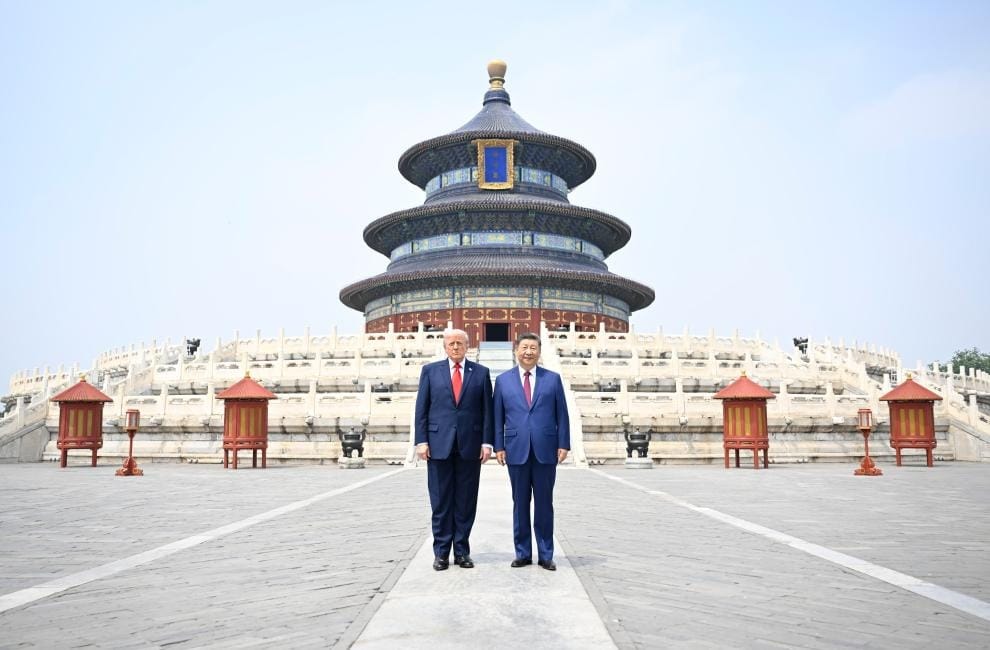
What’s more interesting is how the Chinese side, who is always meticulous and rigid in managing these types of high-profiled events, was willing to “roll with it”, which is much more Trump’s style.
Exhibit A was when NVIDIA CEO, Jensen Huang, was added to the visit at the very last second, apparently after Trump learned from watching TV that he was not on the invite list, then called him to come along. A picture of Jensen showing up and standing on the tarmac of the air force base in Alaska where Air Force One was refueling went instantly viral. Using AI what it does best, many token-generated pictures sprung up all over the internet of Jensen carrying Chinese branded goods, from Moutai to cooking oil to yogurt, ready to board AF1 to join the sleepover party on the plane with Elon Musk and POTUS. (In case it isn’t abundantly clear, Jensen did not bring any of those things; he showed up empty handed with nothing but a backpack.)
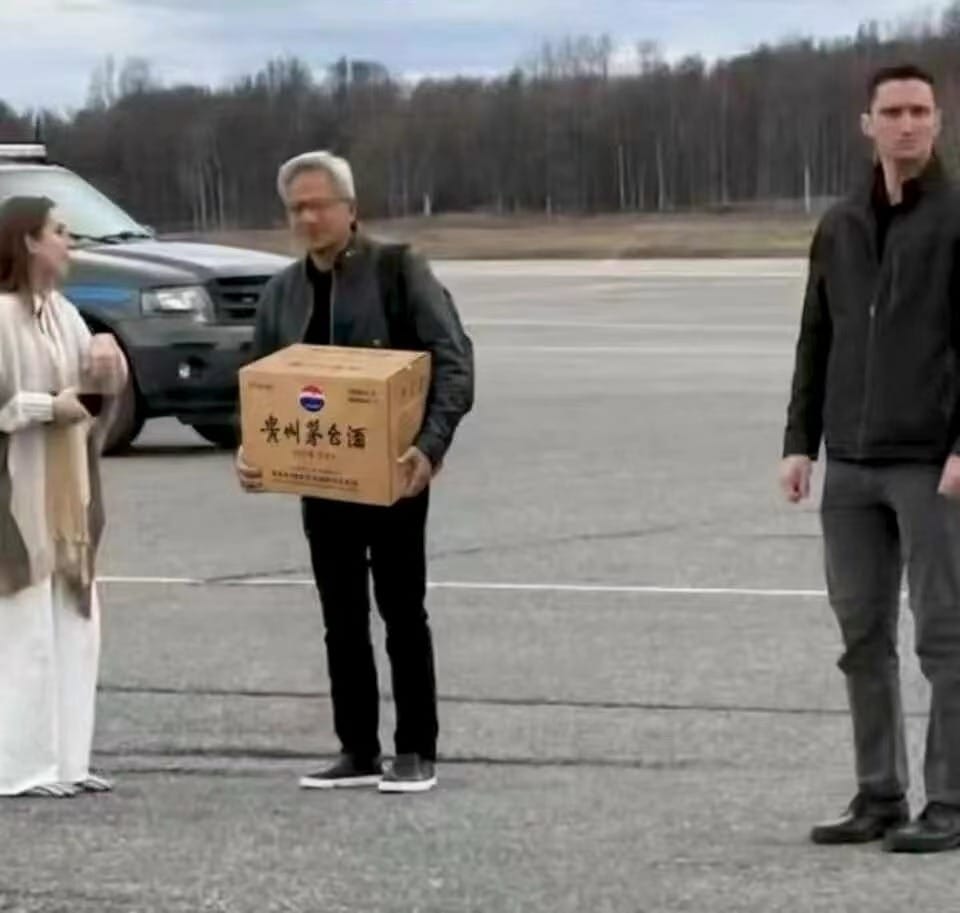
This type of last minute addition to the delegation list would typically be a big no-no, when the manifest of who will be on the plane, who will be attending which meeting, who will be at the banquet would be decided weeks if not months in advance. But the Chinese side rolled with it and accommodated Trump’s improvisational style.
If you think Jensen got a special treatment, because he is wildly popular among the Chinese public and probably well-liked among Chinese officials too (all true), consider Exhibit B: Marco Rubio.
The last time anyone bothered to check, the US Secretary of State and National Security Advisor was still on China’s sanctions list, meaning he would not be allowed in the country by law. Nevertheless, Rubio entered the border without a hitch and got to admire the ornate ceiling of the Great Hall of the People, among conducting other stately businesses.
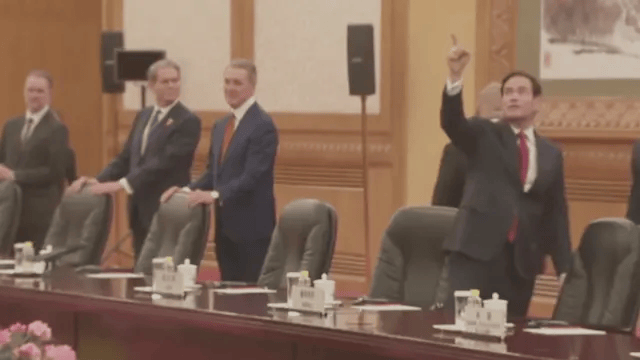
Many theories abound as to what logic China used to bend its own laws as to not cause an awkward moment for the visitors. Some opined that the official Chinese translation of Rubio’s name was altered to use a different Chinese character, thus no custom alert system was triggered. Others conjectured that the interpretation of the travel ban was only for his activities while serving as a US senator, not in his current capacity.
The rationale rarely matters more than the outcome. Xi is willing to accommodate Trump’s style just as much as Trump is willing to play a role in Xi’s.
Just a Couple of Old Men Doing Stuff?
If the point of the whole visit was to show much Trump and Xi genuinely like each other as humans, or at least appear to be on camera, then this trip should be rated a 10 out of 10.
Among the many words of adulation and admiration both leaders hurled at each other, the one segment that stood out the most was Xi giving a personal tour for Trump of the living quarters of Zhongnanhai – the governing compound of all of China’s top leaders, including where Xi lives and works. It was framed as an act of reciprocity for Trump hosting Xi at Mar-a-Lago in 2017.
This segment was rare in both the personal affinity it portrayed and public display of the tour. A solid two and a half minute of the walk and talk was filmed on camera, offering a rare, raw glimpse of arguably one of the most secretive yet powerful addresses on the planet. This footage is likely the first time most Chinese citizens have seen what their leaders' living quarters look like. (By contrast, the White House has always been much more public with daily tours of visitors walking through the various rooms, until the East Wing got torn down to build Trump’s ball room.)
If you watch the entire video (and I hope you do), all you would hear is two leaders of the world’s two superpowers talking about trees. Xi pointed out all the cool trees and told Trump how old they were. Trump admired those trees and marveled at how old trees could live. Xi invited Trump to touch one of the trees. Trump touched the trees and told Xi how much he liked the place.
Just a couple of old men doing old men stuff, talking about old trees.
As if suddenly snapping back into character, Trump, in his typically insecure fashion, just had to ask Xi: “Do you bring other presidents or prime ministers here?”
Right on character, knowing his friend’s ego needs stroking, Xi shook his head: “Extremely rare.” Except a few moments passed after explaining how rarely he conducts external businesses inside Zhongnanhai, Xi couldn’t help but share one example of a person he has done this for: “Putin.”
Did Xi tell Trump that as a jab? Or was he just being honest and genuine with his friend? We will never know. But the Russian president is slated to Beijing on May 20th, five days after Trump departs.
Beef and Boeing (not H200s)
So did any real work get done? Or in DC and media parlance, did the trip accomplish any “deliverables”? Sure!
China committed to buying more American beef and (supposedly) 200 Boeing airplanes. Unfortunately, the Boeing shareholders were hoping for more and were not impressed by this outcome (Boeing’s stock price dropped 7% upon the news). I’m not sure if the beef producers of America were equally disappointed.
But more purchase commitments are coming, as USTR Jamieson Greer teased on TV, to the tune of multiple billions for multiple years. The one purchase commitment that did not come through, and may never come through, is the NVIDIA H200 chips.
These older chips have been licensed by the US side to be sold to China in some limited capacity with restrictions, but China has yet to let them through. Speculations were flying everywhere when Jensen got on AF1 as to whether a deal will be brought over the finish line. All Chinese tech stocks jumped for a hot second in anticipation. That trade faded as fast as a ring of cigarette smoke.
A few hours before writing this post, I joined Prof G Media's livestream to share my thoughts along with the hosts Alice Han and James Kynge on the Trump-Xi summit. During the conversation, we tortured the Super Bowl American football analogy further when talking about the H200 issue, by analogizing Jensen to the quarterback of the game. The more I thought about it after the livestream, the more I saw Jensen as the running back, wanting to carry the ball on every play to plow through the opposition’s defensive line to score a touchdown. Except not everyone wants him to carry the ball. Even though Trump, as the coach of the game, may have drawn up plays for Jensen to shine, the actual quarterback (not really sure who that is to be honest) is calling audibles on the field to keep the ball out of Jensen’s hand.
So the H200 limbo continues, as more beef and airplanes flow (or fly).
AI G2
The one surprising deliverable is an impending dialogue or communication channel between the US and China on establishing AI safety guardrails, especially to prevent non-state actors from obtaining advanced models to do harm. Treasury Bessent first talked about it on CNBC. President Trump later confirmed with reporters on AF1 after wheels up.
If this comes to fruition, it would echo a bygone era of G2, which was very much in the works during Obama’s second term when Xi was invited to Sunnylands, California in 2013 for a summit of equals as America prepared, in a different way, for China’s rise. Fast forward sixteen years later, the G2 dynamic appears to be returning, at least in AI, where the US and China are the two undisputed leaders (though the US is, by all accounts, further ahead than China).
The development of AI G2 is one outcome of this visit that I will be watching most closely for all sorts of reasons. The fact that it is being brought to the table at all, after both countries hosted dueling AI gatherings, while excluding the other (or one not willing to show up) is, I think, encouraging for the safety of all humanity.
But I wouldn’t call this a proper deliverable just yet. We are just starting to talk about talking.
High on Vibes, Low on Substance (and That’s Okay)
In general, this trip is high on vibes and relatively low on substance. But I think that’s okay!
You may hear a lot of “winners versus losers” discussion or complaints about the lack of deliverables in terms of purchase agreements or tariffs rebalancing. I find these complaints somewhat silly.
The fact that this visit happened at all, when it was postponed once given the war in Iran, is in and of itself a "deliverable". There is also no need to sign a bunch of agreements with big numbers attached now, especially for Team USA, if you want to get the most political benefits from these deliverables. Trump has formally invited Xi to visit Washington on September 24, when more average voters will be paying attention to the midterm elections. Pushing for more agreements then and announcing them on our home turf is a much smarter strategy.
As for the Chinese side, while midterm elections aren't really a thing to worry about, Taiwan is. It was brought up forcefully during this visit, and meant to set the tone and draw the line clearly for the rest of the year, before more face to face meetings take place as scheduled. How will Iran play into the Taiwan calculus is a new interconnection that I’m very intrigued by. Do the two issues get commingled into the bilateral dynamic, where Trump asks for help from China on Iran in exchange for loosening the US’s commitment to Taiwan’s defense? Or do they stay on parallel tracks and treated separately?
As the name of my newsletter suggests, I think everything is interconnected. We saw a small glimpse of this commingling in the way the official readouts were presented by the two respective governments. In the Chinese readout, Taiwan was prominently mentioned, but not Iran. In the US readout, Iran was prominently mentioned, but not Taiwan. Both items were, of course, discussed during the bilateral meeting.
At first glance, you may think this is treating the issues separately. I think it is the opposite. Neither side challenged the other’s differing version of the readout. Why? Because both sides understand the other team’s need to play to their domestic constituents, in order to carry on with the relationship. Mention Taiwan and Congress plus 90% of the think tanks will throw a hissy fit. Mention Iran and the spectre of being dragged into America’s war would not be kindly treated in the history books.
I guess you can call this some sort of “G2 chemistry”, while a joint communique where both sides agree to the exact same things down to the punctuation is a relic of the past.
What isn’t a relic is selfies and spontaneous viral moments, colorizing these typically staged and manicured state visits. On this front, Elon stole the show.
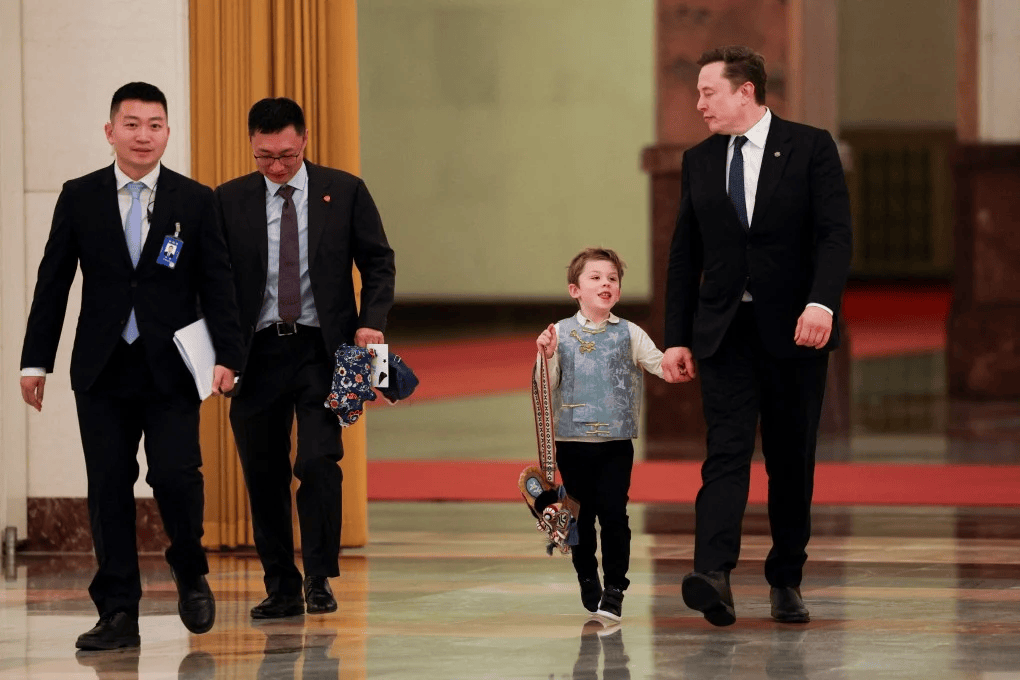
As still the first among equals of the 17 CEOs who traveled with Trump to China, Elon brought his son along and set the internet ablaze when little Elon, who is apparently learning Chinese, walked about with his billionaire dad in a Chinese style vest in the Great Hall of the People.
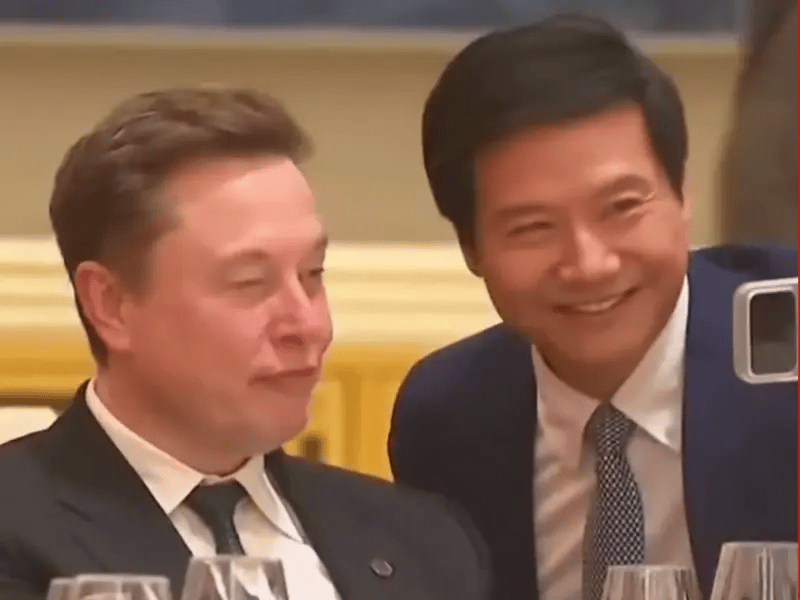
Later that day during the state banquet, he held a one-man selfie station, where American CEOs, like Tim Cook, and Chinese CEOs, like Lei Jun of Xiaomi, all went up to where he was sitting to take pictures. Elon being Elon, he would make funny faces, wink and goof off, and enjoy the moment.
An even more fun and completely unexpected vignette is Bret Baier of Fox News having a great time getting coffee made by a robot, getting a parking ticket issued by the surveillance state, and doing his best to be a normie by playing some pick-up ping pong in the park. If a stuffy Fox News anchor could loosen up and practice a little “street ping pong diplomacy”, maybe we can all relax a bit too and not let all the tension and anxiety get in the way of genuinely human moments.
All in all, this is really not the end of the Super Bowl, but just the end of the first quarter of the matchup. Xi’s visit to the White House in September would be the second quarter. Shenzhen is hosting the APEC Summit in November, where Trump is scheduled to attend – that’s the third quarter. And the final quarter of the game will be played at the Doral Resort in Miami, Florida, where the US will host the G20 Summit.
No championship was ever won in the first quarter. But you could lose viewers if the first quarter was too boring. After all, most people watch the Super Bowl, not for the football, but for the spectacles. The same can probably be said for most of the US-China relations viewership. The first quarter of the US-China Super Bowl was anything but boring – full of spectacles. I will keep watching. I hope you will too.