There are decades where nothing happens. And then there are weeks where decades happen. It’s safe to say that during the last two weeks, decades worth of events happened. When I published my quarter letter, titled “Suitably Paranoid” on October 30th, I did not anticipate my paranoia to be kicked into a higher gear so quickly.
Instead of focusing on just one or two of the developments, many still fluid, I’ll do a quick fire round type post on what I think will or could happen next with several themes that I’ve been writing about for years now. After all, they are all interconnected, perhaps more so than ever before. Threading them together is a more appropriate, if not also more on-brand, treatment.
So, what’s going to happen next with…
…the Data Center Buildout
After the Democrats won a shellacking of a victory on November 3rd (feels like years ago to be honest, what happens when decades happen in weeks I suppose), the biggest overhang to the tech sector is whether and by how much the AI data center buildout will slow when new sheriffs are in town. The data center moratoriums popping up across the country, a trend I have tracked probably earlier than any market participant, became at least a top-three issue nationally, and oftentimes the number one issue that decided many consequential congressional and gubernatorial races.
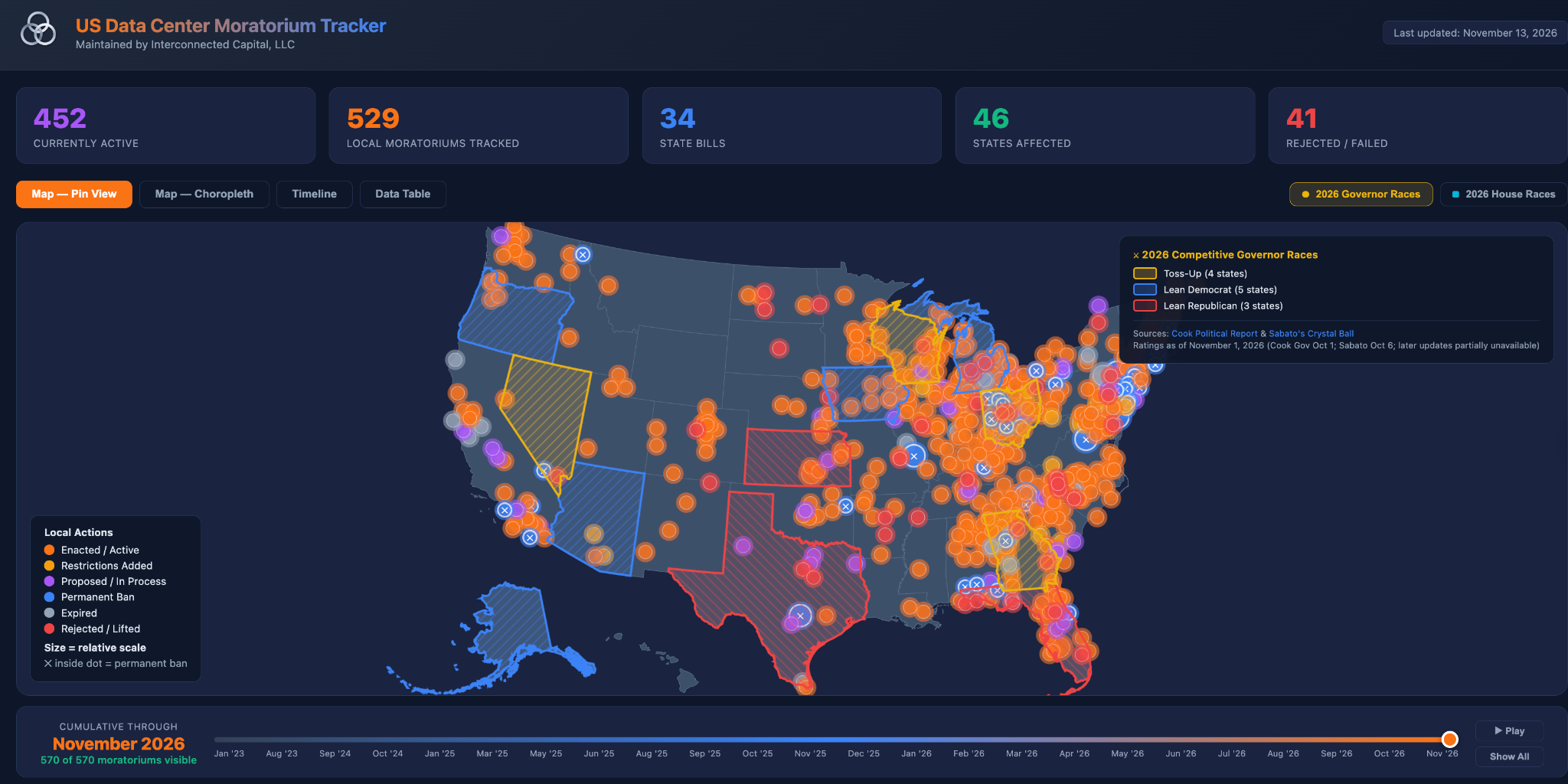
When I first built the dashboard back in March, I overlaid the status of important governor races to see which way certain things were leaning. Even though we already know all the results, I purposely left that visualization on the map to see where the major surprises were. Democratic candidates swept all the governor races, where the data center moratorium bubbles are so dense you can hardly make out the shape of the state on the map. Florida stayed in Republican control, despite all its local moratoriums, but the margin of victory was less than 2%. Of course, Texas was the major surprise that few saw coming, sending all companies connected to the AI build out into a nose dive. Gina Hinojosa’s every appearance, word, and body gesture is now the most closely watched event on Wall Street.
On the surface, it looks like Democrats took full advantage of a partisan anti-data center populism. In truth, the sentiment was shared across many political subgroups. As it turns out, nothing reunited MAGA devotees and progressive socialists more than their shared aversion towards data centers being erected in their back yard.
Again, on the surface, it looks like with more Democrats in power, AI data center buildout will grind to a halt as the new class of elected officials answer to the populism that got them there. Again, in truth, pushing back against AI data centers or big tech in general, is like not the number one or even number two issue the Democratic Party wants to tackle.
The top issue is forcing Trump to end the war with Iran, which would push down gas and diesel prices, which would directly ease inflation pressure, which would help deliver on the affordability problem that was front and center of the Democrats’ midterm election messaging. The second issue is corruption of the Trump administration and the Trump family, when it comes to their dealings with the Middle East, with Russia, with crypto bros, and the myriad of conflicts of interests that have come into the picture since Trump’s second term started. The president’s dealing with tech billionaires could be part of the Democrats’ anti-corruption crusade, which could in turn affect their stance towards data centers, but only indirectly.
What is missing in all the analysis so far is that one very important political constituent actually loves data centers: union workers. From electricians, to welders, to every blue collar worker in between, the data center construction boom is the biggest economic uplift this community has had in a long time. And guess which community of voters the Democrats lost badly during the 2024 election that handed Trump his second victory? Unions! The fact that the Teamsters president spoke at the Republican Convention in 2024, a first in the union’s 120-year-plus history and a stinging rebuke to the Democrats, was not lost on anyone who watches the shifting political wind in America closely.
Democrats want to win back the White House. Winning the midterms and governors are all nice, but it is just an intermediate step on the road back to power. Democrats cannot win back the White HOuse in 2028 without overwhelming support from the blue collar unions. Thus, don’t be surprised if Democrats start embracing the data center buildout in their own way, with their own flavor, if only because their future political roadmap depends on it.
…the NVIDIA-Anthropic Rivalry
Before the dust of the midterm elections settled, Anthropic, as predicted, launched its IPO roadshow to great fanfare. And almost as quickly, headlines after headlines on Jensen Huang’s many affairs, including one with a possibly Chinese spy tumbled into all of our timeline. And before most people could even catch up on who is what, Jensen resigned and is no longer NVIDIA’s CEO.
Sentiment-wise it is clear as day that Anthropic is on the up and up, while NVIDIA is spinning in the proverbial toilet trying to not get flushed down into the drainage, and into oblivion. Quite often, these two firms are pitted against each in many public narratives, where one side’s gain must be the other’s loss, and vice versa.
This zero-sum characterization is true in some specific areas for sure. The two camps are diametrically opposed when it comes to all things related to export control of China. On this set of issues, NVIDIA has lost a ton of credibility due to Jensen’s personal trouble, so Anthropic’s policy objectives will likely win out in Washington, DC, and in short order, likely before 2026 expires for good.
NVIDIA and Anthropic also hold, more or less, opposing views on open source vs closed source and fighting it out publicly. The dynamic of this issue is more complicated than the China export control one. On export control, NVIDIA is singular in its view of wanting to loosen it. On open source, Anthropic is singular in its position of wanting to restrict it. The support for more open source AI is industry-wide, if not worldwide. NVIDIA is leading the charge. It is also putting billions of dollars where its mouth is, from investing in Nemotron (its own open source AI models) to funding and acqui-hiring a long list of neolabs that are also building in the open.
Supporting open source is as big of an issue for Jensen as loosening export control. Those two things often get conflated into one, because of the China nexus, but really should be separated. That’s because the desire for more open source AI to counterbalance the growing Anthropic behemoth is shared across most companies in tech, and also most countries that want to adopt AI and make it sovereign. Without Jensen, the open source AI push is losing a key spokesperson and billions of dollars in support. But someone else will pick up that mantle, while no one will pick up the baton of loosening export control.
How does Jensen’s downfall affect Anthropic’s IPO, due to start trading next week?
I think it’s actually a neutral event, and doesn’t positively or negatively affect Anthropic’s journey to becoming a public company. The IPO still needs to be a blockbuster success for the entire AI trade to continue and for Anthropic to be able to afford more compute, much of which will go to paying for NVIDIA products. One of the most impressive slides from Anthropic's roadshow slidedeck is how Mythos class models can port workloads from one type of silicon to another in days, when it would typically take many months. The slide, of course, featured AMD, a not so subtle dig at NVIDIA.
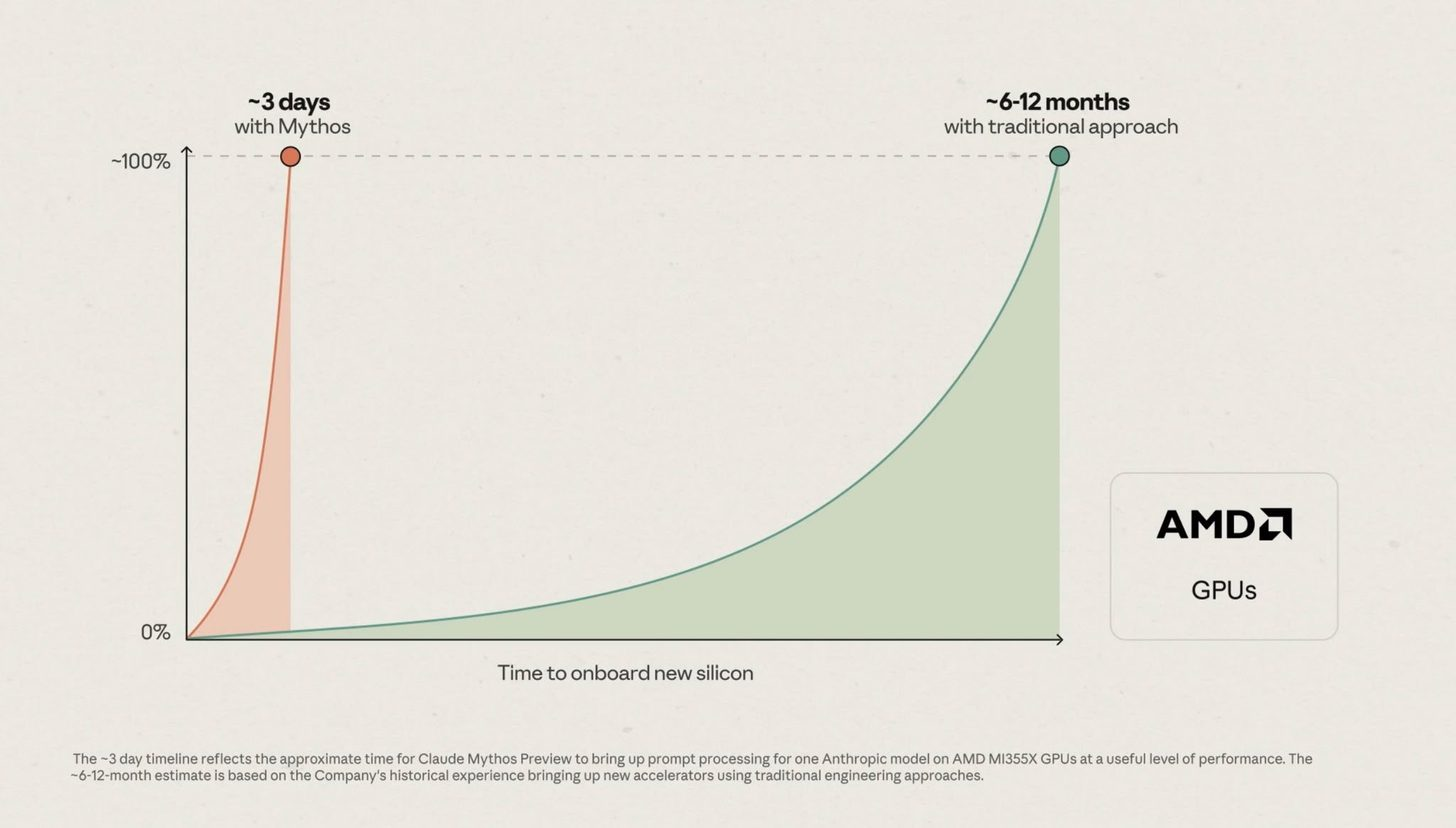
I do think Anthropic's multi-silicon approach is one of the greatest strengths. The industry’s aversion to over relying on NVIDIA silicon is also not new. The growing capability of models at coding, especially low-level kernel-level coding, is also eroding whatever moat CUDA has left. NVIDIA already has its work cut out fighting to keep TPUs, Trainiums, MIXXX, and custom silicons at bay. Of course, Jensen’s personal affairs and resignation does not make that fight easier.
In the grand scheme of things, as I told the New York Times, “NVIDIA and Anthropic’s future are more intertwined than ever before.” Don’t forget, NVIDIA will be one of Anthropic’s corporate anchor investors in its IPO too, to the tune of another $10 billion. Their relative position and leverage over each other might have shifted in the last two weeks, but if one fails, the other does not thrive.
…the AI Trade Overall
It is safe to say that the easy money in the so-called “AI Trade” is over, as I’ve called out in my quarterly letter even prior to the midterms. It is also a good thing, as the fast money chasing the easy money will leave the scene, while the longer, slower, but more sustainable phase of “AI Investing” (not trading) will take place.
While the short term price action can be painful for many investors, where good risk management is more important than ever, all this short-term pain is a healthy transition. The industry does not need hundreds of neoclouds. A few good ones who know what they are doing and are in it for the long-haul is enough. The wave of data center moratoriums throughout the year was already squeezing the long-tail of fast money speculators. The Democrats’ midterm victory is further squeezing them. The cost of capital going up thanks to inflation and (reflexively) the debt that everyone is taking on to build AI infrastructure is further further squeezing them. And Jensen’s resignation, which may put the NVIDIA balance sheet backstop in jeopardy, may be the final squeeze.
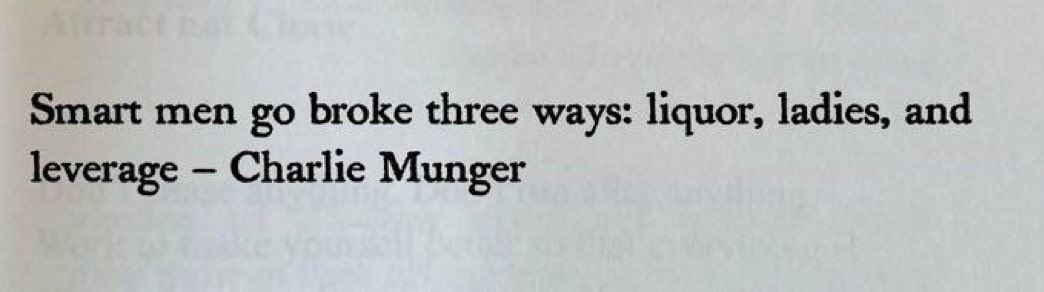
Easy money always creates bad behaviors. This time is no different. The late Charlie Munger once paraphrased of Lord Acton’s famous saying:
“Easy money corrupts. Really easy money tends to corrupt absolutely.”
He said this in 2010 when talking about all the greedy Wall Street bankers, who wrote subprime loans that led to the Great Financial Crisis. If he were alive today, I’m sure he would’ve minced no words about all the shenanigans that have been going on inside the AI buildout, when easy money has been flowing for four years.
In many ways, even Jensen’s personal failings are a symptom of the corrupting power of easy money. I’m not suggesting that NVIDIA’s revenue and profit are easy money. It is actually hard money, earned through relentless innovation, as well as supply chain optimization and relationships, that took decades to iterate and grind out. But the power and fame that ChatGPT ushered in for Jensen, turning him from a five-foot-seven, chubby Taiwanese engineer into the Taylor Swift of AI, a giant among all tech titans and most heads of state, can be nauseating, and evidently corrupting.
…One Wildcard: Jensen Returns as CEO Next Year?
It is almost guaranteed that Jensen will be dragged through the mud of the DC swamp as he endures congressional hearings after congressional hearings, investigations after investigations. Every one will want a piece of him, not his GPUs.
Will that be how his career ends, in shame of the most public nature then fade into oblivion?
That is certainly the consensus view. As an analytical matter, not advocacy, I’m not sure that’s how things will go. If he could absolve himself of any responsibility or culpability that might have endangered national security or trade secrets, either by proving he didn’t leak anything of sensitive nature to Alice Huang and/or somehow demonstrate that Alice Huang is not a spy, at least not a spy in the traditional sense, but just a hustler and smuggler of a businesswoman that he fell for as a “piece of sh-t”, then there is a path for him to return to NVIDIA as CEO again.
It is a very tall order, but not out of the realm of possibility. There is a growing push back on the assumption that Alice Huang is a spy, coming louder and louder from corners where Jensen has enjoyed lots of loyal support. The official stance from various departments within the Trump administration is that it is “inconclusive” whether she’s a spy or not. If this “spy” label ends up not sticking, and Jensen endures the show trials of congressional hearings with discipline, deference, and repentance, and if Nvidia stock price keeps tanking in the meantime, the chorus to reinstate him will be strong.
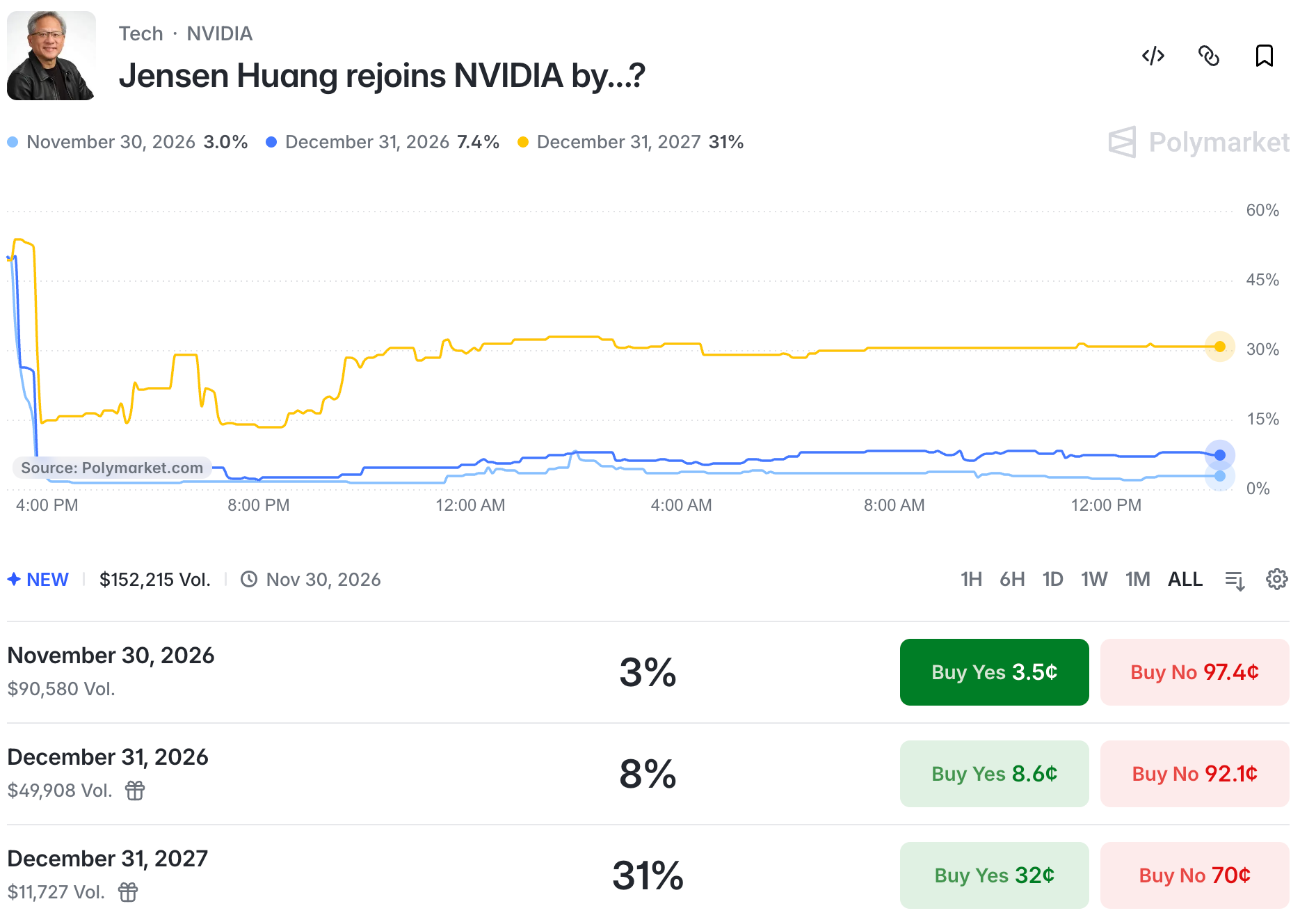
Even today, he enjoys majority support among his rank-and-file employees, and probably unanimous support from his shareholders. If the national security implicated element of his failings end up getting absolved, a big if to be sure, then the next annual general meeting of NVIDIA, which usually takes place mid-year, could mark the moment of his unlikely return as CEO. It may feel like an unimaginable scenario at this moment, but there is a Polymarket for it that you can bet on.
Whether Jensen gets a second chance or not, he will likely be a changed man forever. There is so much to all this drama that we still don’t know and may never come to the public light. But there is always a zinger Charlie Munger quote we can count on for every awful life situation. No matter what happens next with the data center buildout, NVIDIA, Anthropic, the US-China AI rivalry, or Jensen Huang himself, we could all use a reminder of this all-time zinger: