
I have been paying attention to the nationwide AI data center moratoriums for more than a hot minute. I called out this risk in my 2025 annual letter. Our team (as in me and Claude) started tracking local moratoriums and built a public dashboard. When I shared the dashboard in this newsletter in April, it was tracking 55 active moratoriums. Today, the dashboard is showing 183 with two statewide moratoriums or pauses – one in New York, one in the otherwise data center friendly state of Texas.
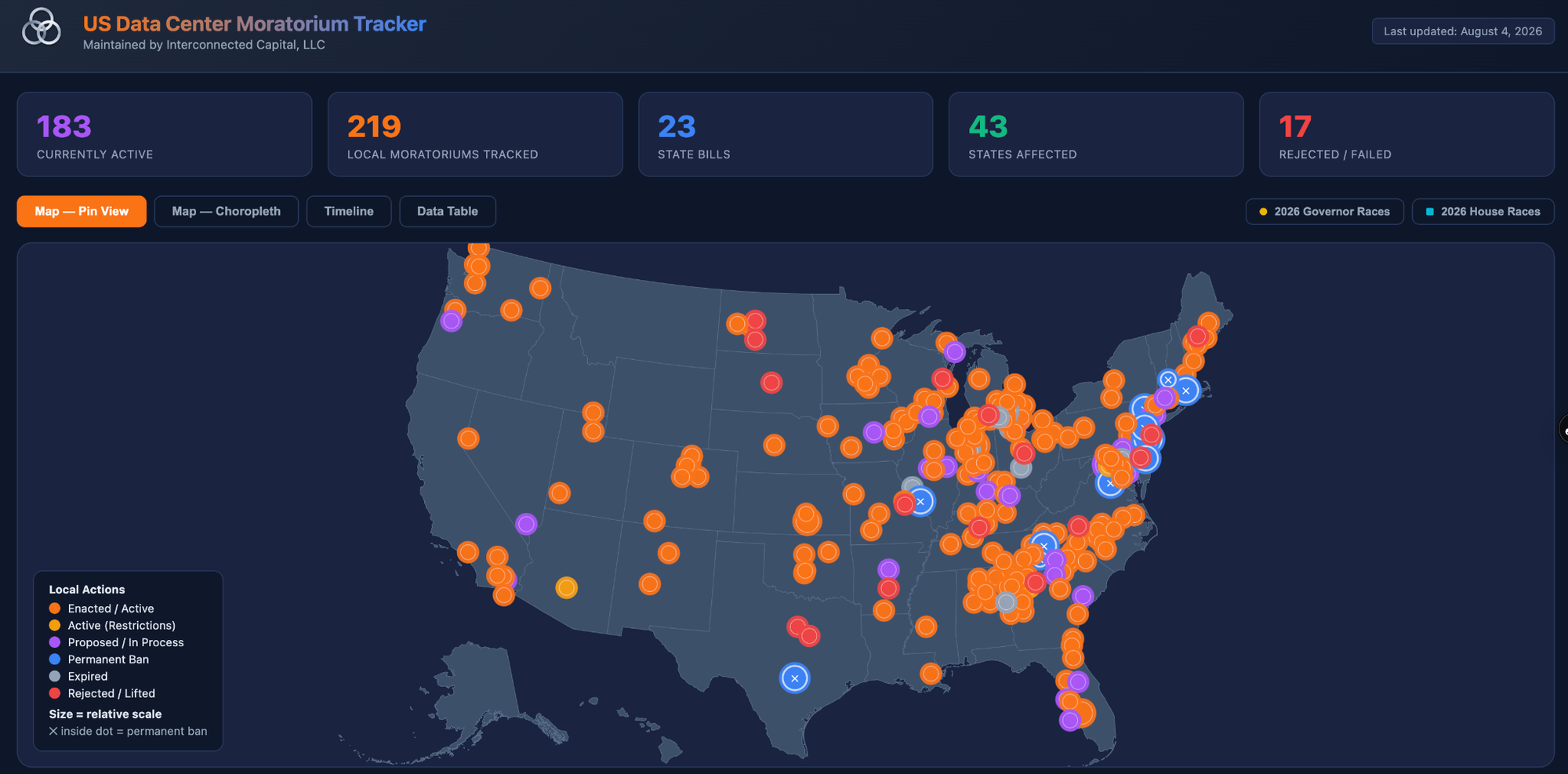
Numbers and data visualizations are cool and all, but the human side of this story tends to get lost. That’s why I read with great interest Jasmine Sun's fantastic, tour-de-force of a reporting piece chronicling her travel through Wisconsin and Michigan to talk to various parties involved and invested in either side of this data center controversy.
 Jasmine Sun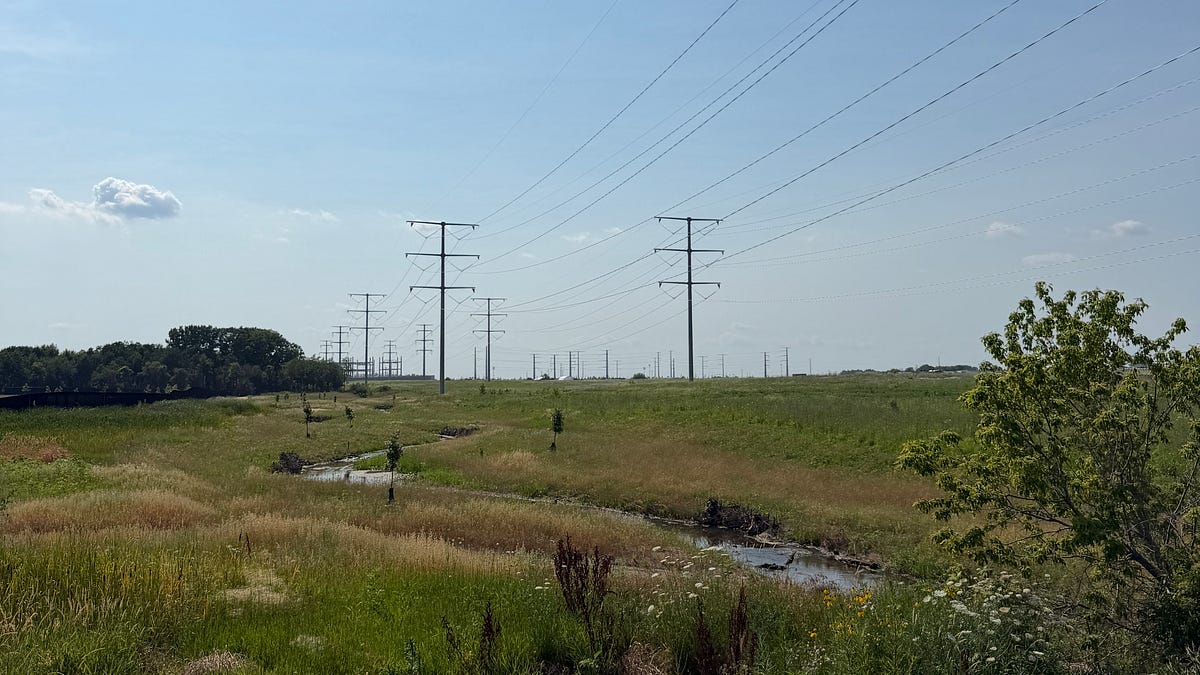
Her entire post is worth reading and re-reading. I learned a ton from it. One particular angle that I have not thought about, but was made clear as day from her conversations on the ground, is how aware the anti data center activists are of the precarious business models of all the major AI players. And if AI were a bubble, they don’t want to be stuck with a defunct, empty, or half-finished data center when the bubble pops. What these activists may or may not have known or intended is that slowing the data center buildout, and thus denying revenue for AI hyperscalers and frontier labs, could accelerate the bubble popping.
This passage with activist Sarah Babbs of Saline, Michigan, drove this sentiment home:
“Sarah—like many others—is worried that AI is a bubble. ‘They’re not making money, their business model’s failing, their product isn’t even that good,’ she contended. In that world, could the AI companies still cover the cost of the grid expansion? Would they build the berms to hide the dirt piles? Would the buildings end up as stranded assets, abandoned like the dead factories, left as waste for her community to clean up? ‘It feels like supporting what happened right before the 2008 crash.’”
This real fear to avoid holding the bag may become a self-fulfilling prophecy.
From Cash to Debt
Although almost all the moratoriums are enacted on the local level, their collective effects could have national and even global repercussions at this delicate moment. The market is feeling increasingly less lenient about the massive data center capex, because more and more of it is being funded with debt, not cash.
During the earlier phase of the buildout, call it 2023 to 2025, investors and the capital market at large generally accepted the already eye-popping investment numbers at the time. That’s because the money at least came from the cash generated by the big tech companies’ existing businesses to fund future growth with AI, however speculative.
That dynamic is starting to change.
Among four big tech companies – Meta, Google, Amazon, Oracle – their combined corporate bond issuances (aka debt) has increased from barely nothing three years ago, to more than $100 billion last year, to almost $200 billion year to date, mostly to fund more data centers. Meanwhile, the free cash flow that used to fund these investments are dwindling. And this is not including the long list of GPU neoclouds, all of which have done a fair amount of borrowing too.
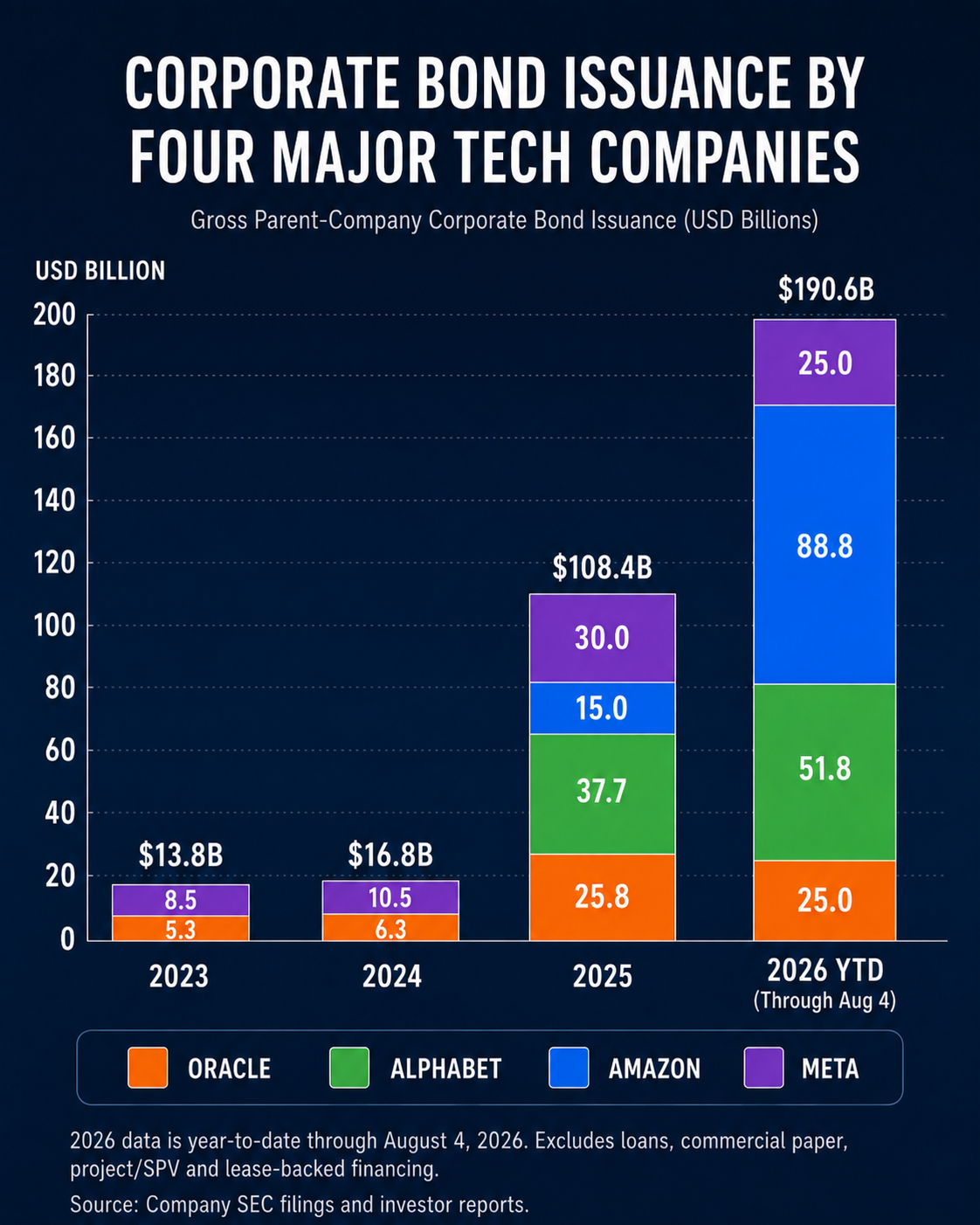
This is happening not only because there is more building to be done to meet AI demand, but also that some of the hyperscalers are running out of free cash flow to fund it all. Google’s earnings announcement last week showed its quarterly free cash flow go negative for the first time ever (!), since becoming a public company in 2004. Meta’s earnings report showed a more than 90% drop in free cash flow quarter to quarter, though still (barely) positive. Amazon and Microsoft’s reports threaded the needle perfectly in showing massive growth in its respective cloud divisions driven by AI, while still remaining healthily free cash flow positive and keeping pace with new data center investment.
So it is not all debt and all bad news. Google Cloud is growing at an astonishing 80+% rate, so the borrowing and capex is (more likely than not) money well spent. Meta’s story is more precarious, but too early to tell.
What is not too early to tell is that there will be more debt-fueled AI data centers in the future than in the past. The only way for the bubble to deflate gently, not pop violently, is if the AI-related revenue with a decent profit margin pours in faster than the debts are issued out.
This “thread the needle” moment is not supposed to happen two years ago, nor can it wait to happen two years into the future. It needs to happen now.
Threading the Needle with Debt
It is hard enough to thread this needle and bridge this delicate transition from cash to debt to (high quality) revenue-funded AI buildout. A wave of data center moratoriums could lengthen the transition from debt to revenue, so more companies may have to borrow more or borrow for longer, even though the demand and revenue potential is evident. Amazon CEO, Andy Jassy, said on the company’s earnings call that:
“Once a data center opens with servers plugged in, we start generating significant revenue right away and then get to monetize these data centers for 30-plus years without having to spend that start-up capital again.”
These chips, servers, and networking equipment are much more flexible, with a better-oiled supply chain, and operate on a shorter time frame. With AI demand still strong, these equipment can generate revenue from the second they are turned on. But they need a building – a large, concrete, powered-up, kind of noisy, and kind of ugly warehouse of a building – to be turned on! And the local activists, like Sarah of Saline, who don’t want to be saddled with the aftermath of a debt-ridden bubble may end up causing it, by fighting against this building being built in the first place.
There is nothing wrong with borrowing debt to invest, as long as the investment pays back before the debt comes due. And there is every indication from the hyperscalers’ earnings reports that investments in AI are paying back. But if the payback period of capital expenditure gets lengthened by local politics, while the cost of borrowing is going up (30-year treasury yield has been more than 5% for more than a month), the debt burden may end up popping the bubble just as the needle was about to be threaded.