
A key risk to the AI infrastructure buildout I identified in my annual letter was a country-wide, bipartisan pushback against all the constructions. It is one of those risks, like any risk, that you don’t want to be right on, but as a responsible investor, you have to be clear-eyed about it and react accordingly.
Looks like this risk is on the “right” track faster than I had anticipated.
To track the development of this risk, we built an internal dashboard to track moratoriums against AI data centers – the bipartisan punching bag. A public version of this dashboard is now hosted in the “Research” section of the Interconnected Capital website for all to view.
The data covers all moratorium announcements from January 2023 to the end of March 2026, covering the entire timeline since the ChatGPT moment. I specifically prioritized local news sources over large national outlets or mainstream media, because most of these actions are coming from local governments, so only local media would cover them comprehensively. As you can see in the demo video, moratoriums started popping up with increasing frequency starting in Q4 of last year and intensified as this year went on.
Navigating the Dashboard
The main dashboard has two buttons on the map you can click on to overlay two political elements – competitive gubernatorial elections and House of Representative races. I plan to add additional overlays of this type, perhaps competitive mayoral races or state senate races, to drill down further on the venn diagram between local political dynamics and data center moratorium momentum in various locales. (I welcome your suggestions.)
There are three other tabs worth clicking on:
“Data Table”: this tab shows the spreadsheet of the data and all the sources that fed this dashboard. Links to the sources are available for verification. This spreadsheet will be updated every two weeks and synced with the dashboard.
“Timeline”: this section shows the lengths of each of the moratoriums that our dashboard is tracking. As you can see, most of the active moratoriums are one-year pauses. We are only tracking three permanent bans. Other moratoriums are either being proposed or explored.
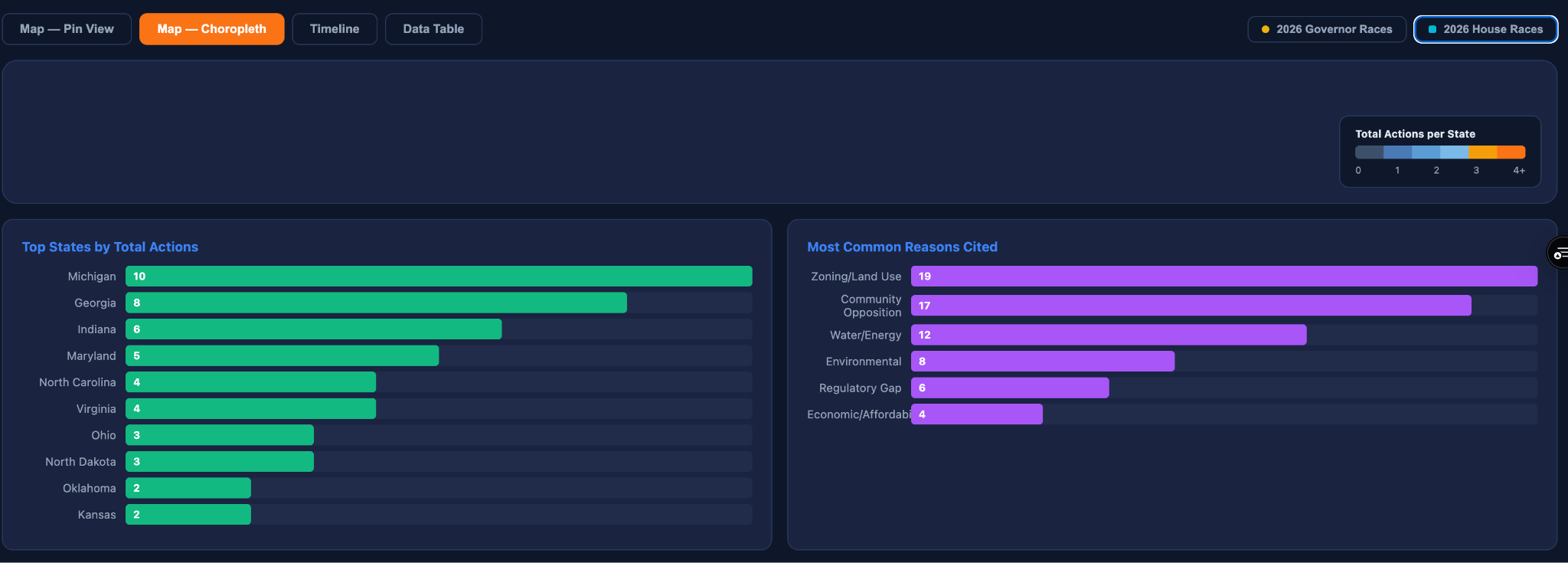
“Choropleth”: this option breaks down the moratoriums into two dimensions. One is rather obvious, geography by state. Michigan is currently leading the way, followed by Georgia and Virginia. The other is commonly cited reasons for the moratorium, which is quite fascinating. Out of the 37 active moratoriums we are tracking, the most common reason is zoning, followed by pure community opposition (NIMBY, against the will of the people) and water/energy impact. These two dimensions will be updated as the data gets updated.
All Politics Is Local
Tip O'Neill, who was House Speaker during the Jimmy Carter and Ronald Reagan administrations during an era when the two political parties actually worked together, said one of the most enduring and timeless summations about politics: “All politics is local.”
These four wise words are showing up again in the midst of arguably the largest industrial buildout since the industrial revolution itself. Evidenced in our dashboard, all of the moratoriums currently in effect were effectuated on the local level. The largest jurisdiction size is county. The smallest goes all the way down to townships. All politics is local, indeed.
Why this is happening deserves a double-click into the nuances and bugs (or features) of the American flavor of democracy as it operates today.
(Time to put on my former political campaigner hat!)
The US political map is very gerrymandered. Even casual observers of politics probably have heard the term before: "gerrymandering". What it means is the map is intentionally drawn to favor one party or the other to win, in perpetuity. For my finance oriented audience, this is financial engineering in the political world, where you are guaranteed to always beat earnings (or win elections) every time.
This means the real competition is in the primary stage – the part where each party hosts a smaller election to nominate their favorite person to run in the general election against the other party. But because the district is so gerrymandered, the general election is more or less already decided; you know which party will win! Thus, the real competition is at the primary level.
The thing with these primary elections is that all the candidates look similar on a policy level (they are all from the same party!). Also, very few people pay attention to or vote in them (usually hardcore activists or die-hard local politics junkies). It is very hard for one person to stand out in a crowded primary, where a few hundred votes can often determine the outcome. Typically, the person with the highest name recognition ("oh I've heard of that name somewhere!") or somehow breaks through by being the loudest or shrillest on a particular issue wins. It is almost entirely a personality contest. The same dynamic more or less holds for elections that select state level representatives, city councils, mayors, some judgeships, even public utilities commissioners.
And guess what is a really good issue to be loud or shrill on, get attention, and boost name recognition in order to rise above the crowd? AI, especially being anti-AI. Data center construction, energy or water price hikes, job losses, children’s safety, the list is long. And some of these are legitimate issues, not pure fearmongering or issue-baiting.
What is unique about data center construction in particular is that not only is it a good issue for local political candidates to raise alarms about, they can actually stop it when elected. Public utilities commissioners can vote against new energy production permits. City council members can vote for a data center moratorium. Junior congresspeople, who are irrelevant in Congress, can be very influential in his or her local district to sway communities.
Most of these officials will have won their seats via a competitive primary process, where AI is the most eye-catching issue (and punching bag) to run a campaign on. And this is a bipartisan dynamic, not limited to districts gerrymandered for either the Republicans or Democrats, even though the Democrats are often cast as the only anti-AI political party. As our dashboard reveals, two states with the most active moratoriums, Kansas and Indiana, both lean Republican for their gubernatorial elections. Two toss-up House races are taking shape in the lean Republican and data-center-heavy state of Iowa, which only has four House seats total.
Diffused Gains, Acute Pains
As I noted in a previous post, “Does AI Have a Zero-Sum Problem?”, the resistance against AI bears echoes to the downfall of globalization and free trade.
The challenge that globalization and free trade ran into is that, while it created immense benefits for millions around the world, those benefits are diffused to the many, but the cost inflicted acute pains on the few. Smartphones and baby strollers became more affordable and better quality as countries and people specialized. Meanwhile, individual factories, companies, and towns and neighborhoods were rendered obsolete and forgotten. How do you make sure you aren’t forgotten? You organize into a larger group, raise a collective voice, find champions (or charlatans) who would support your cause, and push back on the things that caused you these pains.
The outcome is populism winning.
I see a carbon-copy challenge staring in the face of the digital god. The rapid advancement and benefits we have seen from the leading AI labs in the last three years are undeniable and breathtaking. The dashboard I shared with you in this post would’ve taken me a few weeks to build and validate in the pre-AI era. With the help of AI, in my case Claude Cowork, the workload (for me) was trivial. There are many more interesting and consequential examples of AI agents boosting the productivity of all types of knowledge work. They are popping up every day inside big serious corporations and the basements of tinkerers and hobbyists. These benefits are real but come in diffused, small doses.
What is literally powering these gains, however, are concentrated layoffs inside large companies (Meta, Oracle, Block, the list is getting longer), as well as acute pains and confusions in small towns and rural counties, where massive data centers have to be stood up in record time to keep pumping out more tokens as to not rate-limit the next agentic task. Not everyone who is getting active at their local city council meetings to push back are Luddites or AI doomers. But if the cost of offering AI magic for the masses means the few have to bear the cost of disruption, the resistance is all so entirely predictable – a redux of how globalization and free trade played out in these same locales.
The battle between hyperlocal politics and hyperscale data centers are interconnecting and colliding in very consequential ways this year. They are escalating and getting violent. It is a risk that no one can afford to ignore and sleep on.