
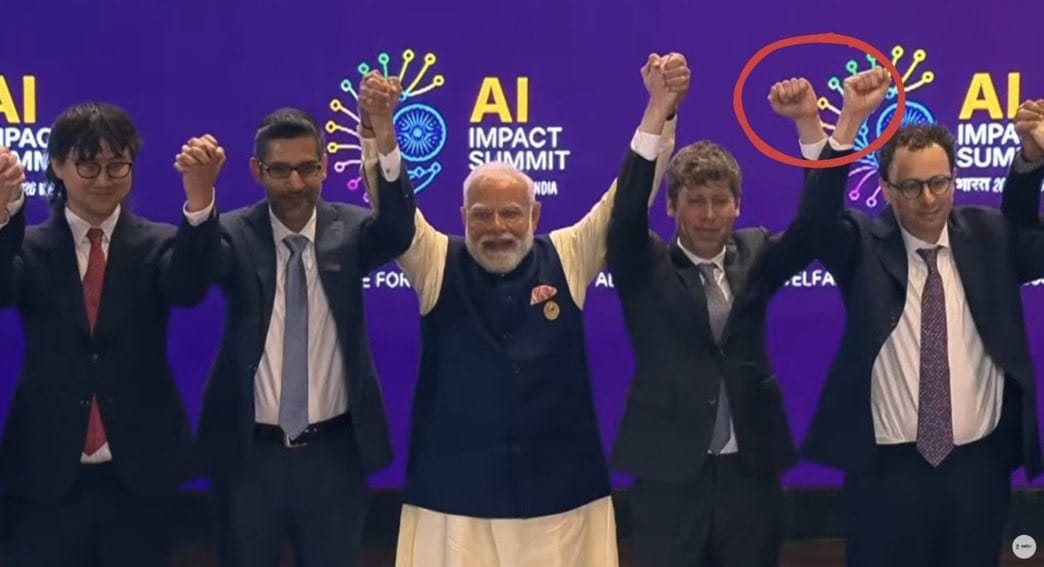
If you follow AI news, or general tech and business news, your timeline and inbox may likely be flooded soon with one image – a photo of Sam Altman and Dario Amodei refusing to hold hands on stage at the India AI Impact Summit in a kumbaya photo-op.
Jokes and memes aside (and plenty will be created from this moment), it is a visceral culmination of something that I have been concerned about: AI seems to have a “zero-sum, us-vs-them, if I win you lose” problem.
This problem does not only run through the rivalry between OpenAI and Anthropic, which is well-publicized and much of it by their own doing (see Super Bowl ads drama). The entire AI complex is being seen from the outside as more of a zero-sum “taker”. A taker of jobs, power, market share, and opportunities from people. In the last couple of months, it is seeping into the public consciousness from multiple different angles. The narrative is gaining mainstream steam.
Take the recent SaaSpocalypse – the severe drop in stock prices of all software companies – as the first example. Whether right or wrong, the market’s reaction implicitly suggests that even though increasingly powerful coding agents like Claude Code can create more software better and faster, that does not lead to software abundance. Instead it comes at the expense of other software companies, even though in theory they should benefit from software abundance.
Take the labor and possible mass white collar unemployment angle. As AI agents become more capable on their own, more CEOs are keeping headcount flat and cutting corporate functions as quickly as possible without triggering too much PR headache. In a milder form, many corporations are also mandating their employees to use AI as a requisite to promotion and advancement. AI agents are seen as replacing or competing with people, more so than supercharging people, no matter how many whitepapers AI labs and big tech firms publish to argue the opposite.
Then take the data center construction boom across rural America (MAGA heartland). Residents in small towns are showing up to zoning board hearings and city council meetings to voice their opposition to weird, gigantic concrete buildings powering advanced technologies purpose-built to give birth to a machine god, while they get stuck in new traffic on the way to church to worship their own god. When these idiosyncratic local worries become enough of a trend to be picked up by both The Daily New York Times podcast and the Financial Times in the same week, it is no longer local nor niche. (I recognize that mainstream media is typically unfriendly to tech and many have ongoing copyright litigation with these AI labs, so the voice is not exactly objective either.)
I’m purposely leaving out the “we have to beat China” angle, because I have beaten that horse plenty of times in previous writing as the ultimate zero-sum, us-vs-them mentality.
Finally, adding insult to injury, the leaders of the two most advanced AI labs can’t pretend to like each other for a split second on stage. Instead of showing the world that AI is in steady, trustworthy hands, they can’t muster enough maturity to touch hands at all!
Even though I am positive and optimistic about the benefits and gains of AI, and putting my money where my belief is, I can’t blame anyone for feeling the opposite.
Echoes of Globalization
As I go through the list of AI’s zero-sum issues, I hear echoes of globalization and the era of free trade.
Globalization and free trade created immense benefits. The problem is those benefits are diffused to the many, but the cost inflicted acute pains on the few. Smartphones and baby strollers became more affordable and better quality as countries and people specialized. Meanwhile, individual factories, companies, and towns and neighborhoods were rendered obsolete and forgotten. How do you make sure you aren’t forgotten? You organize into a larger group, raise a collective voice, find champions (or charlatans) who would support your cause, and push back on the things that caused you these pains. The outcome is populism winning.
AI has similar characteristics. Its benefits are undeniable to anyone who has tried the tools, even casually. Learning new information is faster. Work, especially digital work, is easier. Tedium becomes almost joyful sometimes when you can tell your favorite AI to just “do this”, and it does it! And as I get rate limited on an hourly basis while pestering my local OpenClaw instance to do more things for me, I fully buy the argument that more data centers will produce more AI magic for more people (and of course revenue for the AI companies).
Except just like globalization, the magic is widely diffused to the many, while the cost, confusion and pain are borne by the few. The rural families who don’t code or “claw” for a living. The college grad who is pissed about the lack of job opportunity after enduring a four-year computer science program. (The parents are even more pissed.) The knowledge worker whose day job is to organize Zoom calls, make Jira cards, then tell people to move them into the right column. You may have different degrees of sympathy for these wildly different situations of the “median human”. But they are real people experiencing acute pains thanks to AI. And the list is getting longer.
All this reminds me of a speech that Morris Chang, the founder of TSMC, gave in Arizona three years ago at TSMC’s first tool-in factory ceremony in America. At that ceremony, he proclaimed with profound disappointment that "globalization is almost dead.” The unintended irony, of course, is that his creation – the most iconic beneficiary of globalization – is producing the chips that may be powering yet another populist movement that could be even bigger than the one that killed globalization.

Is This Just a PR Messaging Problem?
In a sense, yes.
Diffused benefits are inherently harder to form a coherent and convincing argument around, while acute individual pains are by their nature more relatable and elicit more sympathy. All AI labs are trying their hardest to tell a story of abundance. They have a growing list of real world, positive-sum impact to work with too, as AI models get better. They sadly have their work cut out for them by their own benevolent dictators, who have become unsympathetic and petty public figures, who dilute that story at every turn.
But AI’s zero-sum problem goes far beyond strategic messaging. The technology is accelerating at such a breathtaking pace that even people like me, who make their living keeping up with it all, can’t. (We all use AI to help us do it too!) As both the benefits and the drawbacks of AI become more visible and visceral, there has not been nearly enough focused attention and dedicated resources poured into helping people adjust to the drawbacks.
This is not the first time this has happened. Tech has always been disruptive and tech has typically been hand-wavy about the consequences and adaptability of disruptions. Retraining and reskilling is a perfect example of this hand-wavy, let them eat cake mindset.
It was dumb a few years ago to tell a 55-year-old union-badged electrician, who was not getting enough projects to learn to code when “software was eating the world.”
It is arguably dumber to tell a 25-year-old junior software engineer, who just got laid off to learn to pour concrete at data center sites now that “AI is eating software.”
Speaking of data centers, anyone who knows an inkling about how they are built and how they operate knows that the job creation and economic benefit for the local community is temporary at best. When the construction is finished in two to three years, the workers leave town to move to the next location, the hotels and restaurants are empty again, and the town recedes from the limelight back to obscurity, much like how globalization treated it years ago.
For the union electricians and construction workers, many of whom have become vocal supporters of new data centers, they know the gig is great but isn’t forever. “Get it while the gettin’ is good!” It is as zero-sum of a mentality as it gets, but also a perfectly rational reaction to something perceived as zero-sum to begin with.
Every AI leader would be doing themselves a favor to learn why globalization and free trade, despite the immense economic benefits produced, became the bipartisan populist punching bag. AI could be the next. Learning to hold hands in public when the moment calls would be helpful too.